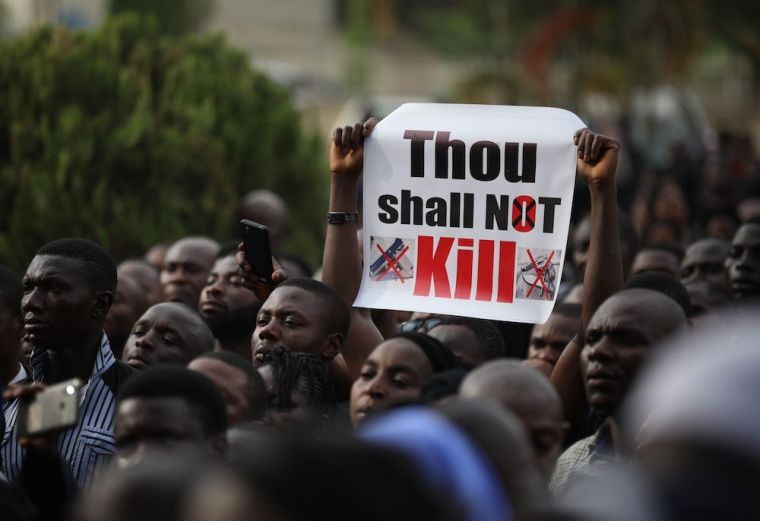
Christians faithfuls hold signs as they march on the streets of Abuja during a prayer and penance for peace and security in Nigeria in Abuja on March 1, 2020. The Catholic Bishops of Nigeria gathered faithfuls as well as other Christians and other people to pray for security and to denounce the barbaric killings of Christians by the Boko Haram insurgents and the incessant cases of kidnapping for ransom in Nigeria. | AFP via Getty Images/KOLA SULAIMON
A Nigerian Christian lawyer and leader of the Emancipation Centre for Crisis Victims in Nigeria is now in hiding after receiving death threats for speaking publicly about the unrelenting attacks on Christians.
Dalyop Solomon has spoken out against the murder of Christians by the terrorist group Boko Haram and radical Fulani herdsmen. He visited villages where men and women were murdered, speaking with witnesses to document what happened.
Islamist militias in Nigeria murdered an estimated 1,202 Christians between January and June of this year. These murders are genocide, according to Jubilee Campaign USA, which submitted its data and research from Nigeria to the International Criminal Court last year.
Those who are attempting to hunt down and kill Solomon are being helped by people outside of Nigeria, an anonymous source claimed in an interview with Nigeria’s Opera News.
"Inside sources revealed on Monday that his photograph has been taken to Saudi Arabia, and his phone contact is being trailed from Abuja (Nigeria's capital) just to have him shot dead or captured alive. His present residence has been traced by some hired agents," the anonymous source said.
Free CP Newsletters
Join over 250,000 others to get the top stories curated daily, plus special offers!
FREE CP NEWSLETTERS
Join over 250,000 others to get the top stories curated daily, plus special offers!
Solomon has spoken out to defend persecuted Nigerian Christians for over a decade. He also tracks and reports attacks against Christians in Central Nigeria and has prosecuted attackers who've killed Christians and destroyed their villages.
After Fulani militants annexed a village where he lived and renamed its school after a Fulani leader, Solomon successfully petitioned the government to return the school to its original name. Although the government didn’t allow Solomon and other displaced residents to return to their homes, keeping the original name was their way of denying legitimacy to the Fulani landgrab.
As ECCVN’s leader, Solomon works to bring justice to Christians displaced by Nigerian Islamist extremist attacks. ECCVN also provides relief for attack survivors.
"His failure to back out from criminalizing Fulani in every [one] of his reports after [a] series of warnings has earned him serious trouble," said a source close to the lawyer, according to Opera News.
Solomon’s investigations of attacks on Christians in Nigeria’s Middle Belt region have enabled him to provide detailed information to The Christian Post.
“So many communities here have been affected and the reason is because of their Christian faith. [Nigeria’s] Middle Belt has been left to its fate. Few Christian organizations have been reaching out to these victims. So that’s why we keep appealing to brethren, Christians across the globe, to come to our aid,” said Solomon in a previous interview with CP.
Now that Solomon is in hiding, he's no longer able to communicate with the media because of the risk that his phone calls might be traced.
If Nigeria’s government receives details of the threats against him, it might further endanger his life, the source told Opera News when asked whether Government Securities had been notified. The government has long kept Solomon on its watchlist because of his defense of Christians.
Islamic extremists and the Nigerian government have threatened Solomon before, and he's escaped previous assassination attempts. The Nigerian Army also warned him to stop reporting on the murders of Christians.
Christians worldwide can help Solomon and other Nigerians by sharing reports about the persecution Nigerians face and asking their governments to pressure Nigeria to take action against religious attacks, Solomon previously told CP.
The United States provided $355 million to Nigeria in aid in 2019. Americans can contact USAID here to urge leaders to speak to Nigeria about Solomon’s situation.
“If the Nigerian government faces mounting pressure that there should be religious freedom, it would be a respite to our religious freedom,” he said.
Nigeria: Christian lawyer receiving death threats for defending victims of Fulani attacks - Where are the Christian state leaders of the World to voice out for the BLOOD of their brethren! Sad day for Christianity.
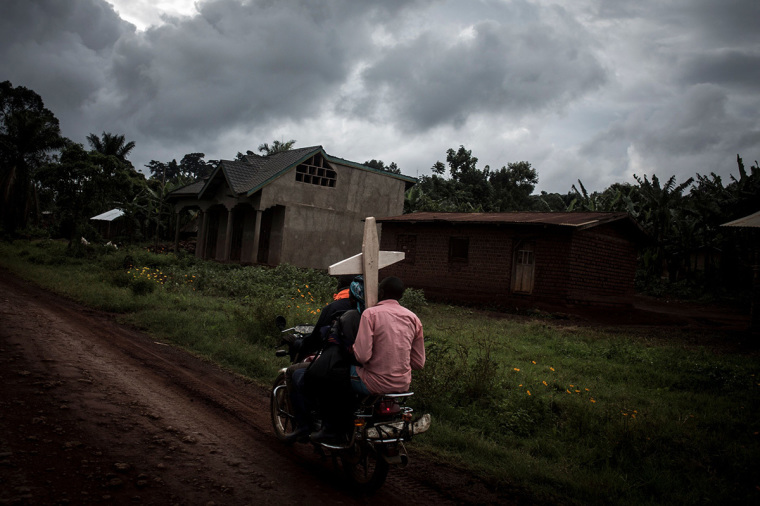
Three Congolese ride a motorbike and carry a cross for a grave along the road linking Mangina to Beni on August 23, 2018, in Mangina, in the North Kivu province. | JOHN WESSELS/AFP via Getty Images
Jihadi terrorists killed at least 30 Christians, raped 10 young women and girls, and abducted several others from churches in a string of attacks on villages in the Democratic Republic of Congo.
According to the Barnabas Fund, the Allied Democratic Forces, an organization that aligns itself with the Islamic State terrorist group, raided five villages in North Kivu province, northeastern DRC, between Nov. 20 and Dec. 3.
Jihadis armed with guns, machetes, clubs, swords and axes reportedly surrounded churches in each of the five villages. Local authorities confirmed reports that the terrorists targeted Christians, killing those who refused to convert to Islam.
At least 15 people were abducted from two churches, while 14 other Christians were transported to a hospital and reported as being in critical condition and suffering from severe injuries.
One Christian survivor witnessed the murder of his wife and three children as he hid in a bathroom. In another village, a pastor lost all five members of his family who were slaughtered after they refused to convert to Islam.
Free CP Newsletters
Join over 250,000 others to get the top stories curated daily, plus special offers!
FREE CP NEWSLETTERS
Join over 250,000 others to get the top stories curated daily, plus special offers!
“They also tried to force my wife and our four children to convert to Islam, but when they refused to convert, they shot my wife in the head while our four children were cut into pieces with a sword,” the pastor said.
Led by Musa Baluku, the ADF has become the DRC’s most active and violent terrorist group over the past two years. The group is known for committing crimes such as murder, rape, and abduction of women and children, as well as slavery and indoctrination.
Attacks against Christians in the DRC have increased since October 2019, when the Congolese Army launched an operation against the ADF’s leaders and bases in the jungle around the city of Beni.
In response, the jihadist group intensified its campaign of massacres in rural areas, predominantly targeting Christians, who make up 95% of the population.
In late October, more than 20 people were killed and many others were abducted in a suspected ADF militant attack in North Kivu province. The terror group is also suspected of carrying out several atrocities in Ituri province, including the murder of at least 58 people in attacks on two villages in September.
According to the Kivu Security Tracker, a research initiative that maps unrest in Eastern Congo, the group has kidnapped 5,361 people since 2017 and violently killed at least 3,971 people.
In over 20 attacks between January and May, an estimated 90 people were killed, including a 9-year-old child and an Anglican pastor. At least 131 people have been kidnapped and over 12,000 individuals displaced, including children and the elderly.
Persecution watchdog Open Doors USA notes that the atrocities committed against Christians in DRC are causing displacement, poverty, desperation, and many health and psychological problems. The violence has also negatively impacted church life.
Islamic extremists kill 30 Christians, rape multiple women in DRC -WHEN WILL MUSLIMS STOP KILLIG AND RAPING CHRISTIANS! What wrong with THEM!! Do they have the RIGHT to do so? The world is so concerned about Islamophobia and minor mistreatments to them. Whereas Christians in Nigeria, Congo, Sudan, etc are ethnically cleansed - butchered like cattle! Palestinians always come to headlines, most of the time due to their own aggressions!
The World should NOW STOP and see what the uslims are DOING in the name of the religion!!!
Rape, abuses in palm oil fields linked to top cosmetic brands: AP
AP investigation on treatment of women workers in palm oil plantations in Indonesia and Malaysia finds sexual and other forms of abuse.
A female worker sprays herbicide in a palm oil plantation in Sumatra, Indonesia [Binsar Bakkara/AP]
18 Nov 2020
A 16-year-old girl describes how her boss raped her amid the tall trees on an Indonesian palm oil plantation that feeds into some of the world’s best-known cosmetic brands. He then put an axe to her throat and warned her: “Do not tell.”
At another plantation, a woman named Ola complains of fevers, coughing and nose bleeds after years of spraying dangerous pesticides with no protective gear.
Hundreds of miles away, Ita, a young wife, mourns the two babies she lost in her third trimester. She regularly lugged loads several times her weight throughout both pregnancies, fearing she would be fired if she did not.
These are the invisible women of the palm oil industry, among the millions of daughters, mothers and grandmothers who toil on vast plantations across Indonesia and neighbouring Malaysia, which together produce 85 percent of the world’s most versatile vegetable oil.
Palm oil is found in everything from potato chips and pills to pet food, and also ends up in the supply chains of some of the biggest names in the $530bn beauty business, including L’Oréal, Unilever, Procter & Gamble, Avon and Johnson & Johnson, helping women around the world feel pampered and beautiful.
The Associated Press conducted the investigation focusing on the brutal treatment of women in the production of palm oil, including the hidden scourge of sexual abuse, ranging from verbal harassment and threats to rape.
The investigation was part of a larger examination that exposed widespread abuses in the two countries, including human trafficking, child labour and outright slavery.
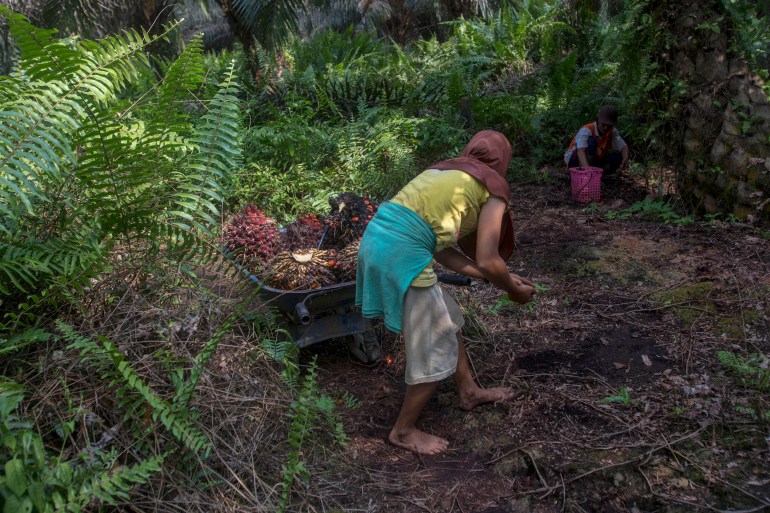
A woman helps load palm oil fruit into a wheelbarrow, navigating barefoot through the rough jungle floor in Sumatra, Indonesia [Binsar Bakkara/AP]Women are burdened with some of the industry’s most difficult and dangerous jobs, spending hours waist-deep in water tainted by chemical runoff and carrying loads so heavy that, over time, their wombs can collapse.
Many are hired by subcontractors on a day-to-day basis without benefits, performing the same jobs for the same companies for years – even decades.
“Almost every plantation has problems related to labour,” said Hotler Parsaoran of the Indonesian non-profit group, Sawit Watch. “But the conditions of female workers are far worse than men.”
The AP news agency interviewed more than three dozen women and girls from at least 12 companies across both countries. Because previous reports have resulted in retaliation against workers, they are being identified only by partial names or nicknames.
The Malaysian government said it had received no reports about rapes on plantations, but Indonesia acknowledged physical and sexual abuse appears to be a growing problem, with most victims afraid to speak out.
Still, the AP news agency said it was able to corroborate a number of the women’s stories by reviewing police reports, legal documents, complaints filed with union representatives and local media accounts.
Reporters also interviewed nearly 200 other workers, activists, government officials and lawyers, including some who helped trapped girls and women escape, who confirmed that abuses regularly occur.
In both countries, the AP investigation found generations of women from the same families who have served as part of the industry’s backbone. Some started working as children alongside their parents, gathering loose kernels and clearing brush from the trees, never learning to read or write.
And others, like a woman who gave her name as Indra, dropped out of school as teenagers. She took a job at Malaysia’s Sime Darby Plantations, one of the world’s biggest palm oil companies.
Years later, she says her boss started harassing her, saying things like, “Come sleep with me. I will give you a baby.”
Now 26, Indra dreams of leaving, but it is hard to build another life with no education and no other skills. Women in her family have worked on the same Malaysian plantation since her great-grandmother left India as a child in the early 1900s.
“I feel it’s already normal,” Indra said. “From birth until now, I am still on a plantation.”
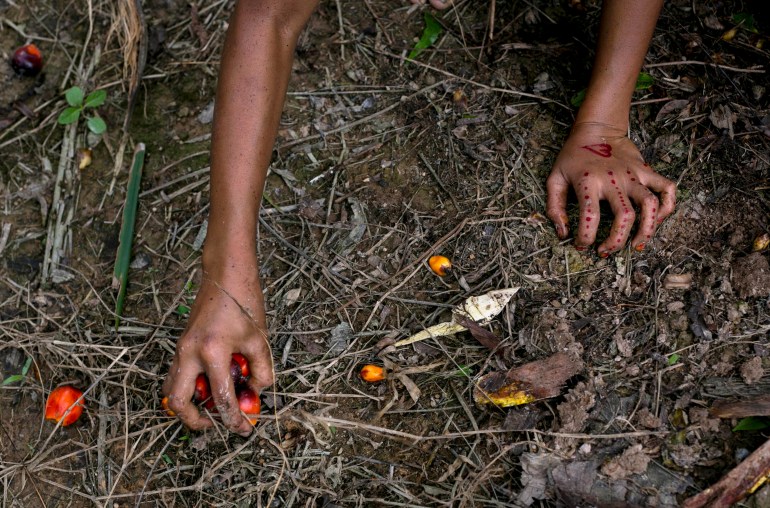
A child collects palm kernels from the ground at a palm oil plantation in Sumatra, Indonesia [Binsar Bakkara/AP]Women have worked on the estates since European colonisers brought the first trees from West Africa more than a century ago.
As the decades passed, palm oil became an essential ingredient for the food industry as a substitute for unhealthy trans fats. And cosmetic companies were captivated by its miracle properties: It foams in toothpaste, moisturises soaps and lathers in shampoo.
New workers are constantly needed to meet the relentless demand, which has quadrupled in the last 20 years. On almost every plantation, men are the supervisors, opening the door for sexual harassment and abuse.
The 16-year-old girl who described being raped by her boss in 2017 said it happened when he took her to a remote part of the estate.
“He threatened to kill me,” she said softly. “He threatened to kill my whole family.”
Nine months later, she sat by a wrinkled two-week-old boy. She made no effort to comfort him when he cried, struggling to even look at his face.
The family filed a report with the police, but the complaint was dropped, citing lack of evidence.
The AP news agency heard about similar cases on plantations big and small in both the countries.
Union representatives, health workers, government officials and lawyers said some of the worst examples they encountered involved gang rapes and children as young as 12 being taken into the fields and sexually assaulted by plantation foremen.
While Indonesia has laws in place to protect women from abuse and discrimination, Rafail Walangitan of the Ministry of Women Empowerment and Child Protection said he was aware of many problems identified by the AP news agency on palm oil plantations, including child labour and sexual harassment.
Malaysia’s Ministry of Women, Family and Community Development said it had not received complaints about the treatment of women labourers and offered no comment.
Many beauty and personal goods companies have largely remained silent when it comes to the plight of female workers, but it is not due to lack of knowledge.
The powerful global industry group, Consumer Goods Forum, published a 2018 report alerting 400 CEOs that women on plantations were exposed to dangerous chemicals and “subject to the worst conditions among all palm oil workers”.
Most cosmetic companies contacted by the AP defended their use of palm oil and its derivatives, with some attempting to show how little they use of the roughly 80 million tonnes produced annually worldwide.
Others pointed to pledges on their websites about commitments to sustainability and human rights or to efforts to list their processing mills in the name of transparency.
The AP used United States Customs records, product ingredient lists and the most recent published data from producers, traders and buyers to link the labourers’ palm oil and its derivatives from the mills that process it to the supply chains of almost all big Western brands – including some that source from plantations where women said they were raped.
Abuses were even linked to product lines sought out by conscientious consumers like Tom’s of Maine and Kiehl’s, through the supply chains of their giant parent companies, Colgate-Palmolive and L’Oréal.
Coty Inc, which owns CoverGirl, did not respond to multiple AP calls and emails.
Estee Lauder Companies Inc, the owner of Clinique, Lancome and Aveda, refused to disclose which products use palm oil or its derivatives but acknowledged struggling with traceability issues in filings with a global certification association that promotes sustainable palm oil.
Both companies, along with Clorox, which owns Burt’s Bees Inc, keep the name of their mills and suppliers secret. Clorox said it would raise the allegations of abuses with its suppliers, calling AP’s findings “incredibly disturbing”.
Some of the women on plantations regularly haul tanks of toxic chemicals on their backs weighing more than 13kg (30 pounds), dispensing 302 litres (80 gallons) each day.
Workers who haul agrochemicals daily had milky or red eyes and complained of dizzy spells, trouble in breathing and blurry vision. Activists reported that some totally lost their sight.
Ita, who has worked on the plantation alongside her mother since the age of 15, was among those who said her work affected her ability to deliver healthy children. She lost two babies, both in the third trimester.
“The second time, I gave birth at seven months and it was in critical condition, and they put it in an incubator. It died after 30 hours,” Ita said.
“I kept working,” she said. “I never stopped after the baby died.”
Rosmah netted over half a billion dollars worth of fancy diamonds out of the money looted from 1MDB, as did senior figures in Abu Dhabi. And guess what: Prime Minister Najib authorised the entire heist from start to finish.
These are just some of the key takeaways from the latest scoop from Al Jazeera, who have obtained an exclusive update on the fugitive fixer Jho Low’s whereabouts, which includes several of his recorded confessions in which he points the finger at key suspects over 1MDB, as he sought to broker a deal to secure his freedom last year with the Malaysian authorities from the past government.
The report confirms that Jho Low has been receiving high level Chinese protection, residing with his entourage in the Macau home of a senior member of the Communist Party.
It also reveals he has been travelling the world as late as November of last year, thanks to yet another of a series of island passports which appear to have been obtained through the company Henley & Partners – the latest being identified as having been issued in Grenada.
Jho Points The Finger
The November trip took Jho to Abu Dhabi, where he fled the day before agreeing to meet with Malaysian negotiators who had been attempting to reach a deal with the fugitive, who had sought to present his thefts as a ‘loan’ which he was now willing to return. Jho Low later reached a settlement with the US Department of Justice in which he surrendered all assets seized.
Tellingly, during his conversations with Malaysian negotiators during the period when the previous PH government were fully engaged in trying to track down the miscreants involved in the scandal, Jho Low identified ‘the people’ in Abu Dhabi as one of the main players responsible and suggested the country still owed half a billion dollars stolen from the funds.
Sarawak Report has obtained bank records which showed that over $500 million was diverted into the Vasco Trust account held in the name of the Aabar/IPIC sovereign wealth fund CEO Khadem al Qubaisi (‘KAQ’, now jailed) at the Edmond de Rothschild bank in Luxembourg.
His boss at IPIC was the royal Prince Mansour who ultimately signed off together with his brother the Crown Prince on a strategic partnership with Malaysia over 1MDB, which included bogus guarantees for the money borrowed by the Malaysian fund.
In July, a Department of Justice filing on the case confirmed that $160 million of the money from the Vasco account was spent on repaying the loan on Prince Mansour’s private yacht, Topaz. Hundreds of millions were also spent on cars, properties and racing car teams connected to KAQ and funnelled into the Hakkasan nightclub and entertainment empire based in the UK and US, which was subsequently re-absorbed into Aabar.
The PH government had pursued vigorous legal action against Abu Dhabi for its alleged complicity in the fraudulent bond issues raised for 1MDB by Jho Low with the connivance of Goldman Sachs, including demanding billions in recompense and the repayment of the kickbacks. However, efforts under PN have collapsed in all directions and the new administration has admitted it has suspended court action in pursuit of a settlement. Despite months of inactivity no solutions have been announced.
Rosmah’s half billion dollar diamond heist!
Al Jazeera say they obtained their information through records and recordings obtained via insiders in Malaysia. Jho Low, they say, shows no remorse or regret for his own actions in the affair and he was also ready to blame the senior figures he said had obviously put him up to the job.
Without authorisation from Najib, he confirms, he could never had carried out the huge loans and transfers from Malaysia that ultimately ended up in his bank accounts and also Najib’s and those of his step-son Riza, along with the other conspirators paid off along the way.
Keeping Rosmah happy was a big part of his task reveals Jolly, who quotes Jho Low in saying that the notorious $27 million dollar pink fancy diamond referred to in Department of Justice court filings represented just a fraction of the haul of precious gems he bought with the stolen cash. He claimed at least half a million dollars worth of 1MDB money went on jewellery for Rosmah.
The Penang born fraudster also refers to the ‘tall story’ that Najib has stuck to for years, claiming that the $681 million which Sarawak Report identified in his AmBank account had arrived as a gift from then King Abdullah of Saudi Arabia.
A gift had been made, Jho Low confirms, however it was a fraction of that sum, which had indeed been siphoned back out of thefts from the Goldman Sachs bonds raised by 1MDB.
Watch for the full details and listen to Jho Low’s own recorded confessions direct from Al Jazeera (details upcoming).
Jho Low Spills The Beans From Hiding In Macau! And WHY is Najib still walking around - He already has a 12 yr imprisonment term!!! Put him in jail NOW!!!
Clarification Or Blaming Everyone Else For His Own Crass Comments?
30 October 2020
MISREPRESENTED CONTEXT 30 Oct 2020
1. I am indeed disgusted with attempts to misrepresent and take out of context what I wrote on my blog yesterday.
2. Those who did that highlighted only one part of paragraph 12 which read: “Muslims have a right to be angry and to kill millions of French people for the massacres of the past.”
3. They stopped there and implied that I am promoting the massacre of the French.
4. If they had read the posting in its entirety and especially the subsequent sentence which read: “But by and large the Muslims have not applied the “eye for an eye” law. Muslims don’t. The French shouldn’t. Instead the French should teach their people to respect other people’s feelings.
5. Because of the spin and out of context presentation by those that picked up my posting, reports were made against me and I am accused of promoting violence etc on Facebook and Twitter…….. etc etc ……
2. However, some arrogant political types find it impossible to ever back down, say sorry, admit fault or just shut up.
3. Despite his other qualities ex-PM4/7 has amply proven himself to be in that category by this petulant blaming of everyone but himself for his own ill-timed and inappropriate comments that were crassly designed to curry favour with Muslim groups.
4. Instead of issuing a clarification and gracious apology for those remarks he has now moaned he was meanly ‘misinterpreted’.
5. Dr Mahathir has criticised the US President over just this form of behaviour, but fails to see it in himself.
6. Right thinking people, including Muslims, are therefore embarrassed and appalled.
7. There is only one way to respond to an outrage such as took place in a church and on the street in France, which is to issue a SHORT statement of respectful condolence and to condemn violence against unarmed civilians for which there are no excuses.
8. Everyone knows that. Except, it appears, this self-important old fellow who decided it was the moment to treat the world to in depth lectures from himself about perceived historic injustices that may or may not underpin this incident, but will NEVER justify such vile acts.
9. Next advised step? Hire a decent editor and issue thanks to Twitter for intervening to warn against your inappropriate remarks.
10. Better still, retire.
YES, agreed Dr. M. should retire with immediate effect. And not get into politics ever aain!!!
How The 1MDB Expose Caught Up With Trump's Top Fund Raiser
9 October 2020
As Sarawak Report indicated last month, after the lobbyist Nicky Lum Davies pleaded guilty to secretly working for Jho Low to influence the Department of Justice and the White House over 1MDB, charges against Elliot Broidy could only be a matter of time.
The role of the former chairman of the Republican National Committee had already been laid out in excruciating detail in Lum Davies’ own indictment for breaking the Foreign Corrupt Practices Act.
It was learnt that Broidy had accepted an up-front fee of $8 million (paid by Jho Low through a company owned by rap star Pras Michel) and was demanding a ‘success fee’ of a further staggering $75 million if the case was dropped.
The payments were secreted to his wife’s law firm on the pretext of non-existent legal services in Jho Low’s case against asset seizures linked to 1MDB (opening to question her continuing licence to practice as a lawyer).
Organising a game of golf between President Trump and Najib was a key target of the conspirators and, as the latest filings from yesterday spell out, this was the occasion where Najib was hoping to talk the President out of the proceedings against 1MDB.
Sure enough, the papers were full of the story yesterday, as the gory details of the shameless influence mongering were once again spelt out as the DOJ inevitably made its move against Broidy himself.
A suggested guilty plea to avoid the whole affair being battled out in court reminded Broidy that the recommended sentence for his crime is up to five years in jail and a major fine. It is being widely speculated that Broidy will accept the plea in return for a lesser sentence.
He will become one of a growing circle of Trump’s close political associates and top Republicans who have been charged and convicted of corruption and indeed of senior figures caught out accepting kickbacks thanks to 1MDB.
Sarawak Report first broke the story about Broidy way back in March 2018 after receiving a series of leaked emails and documents from a network known as Global Leaks. Whilst other recipients in the media focussed on documents more related to US concerns, Sarawak Report explored in detail Broidy’s relationship to issues in Malaysia and his greedy bid for further business from Najib.
The bribes from Jho Low on behalf of Najib plainly put a whole new light on the Malaysian prime minister’s invitation to the Whitehouse the previous November, which had surprised many given the 1MDB investigation.
And, this was not the only business going on with Broidy. The leaked documents showed that the key Republican fundraiser was far advanced on a separate deal with Malaysia for his ‘private security’ firm Circanium, to allegedly provide internet security for Najib’s government.
Presented on May 4th 2017 the five year contract was pitched at a whopping US$42.5 million per annum, rising year on year, with a US$25 million up-front payment. That arrangement appears to have collapsed following the failure of Najib’s visit to obtain the desired game of golf with Trump or to end the DOJ investigation on 1MDB. It was a crushing failure for the Malaysian PM who found himself mocked for his grovelling approaches.
Broidy had hoped to continue his lucrative relations with Malaysia, moving from lobbying on to ‘security service provision’
The facts having thus been brought out into the open by the media the FBI took up the case in yet another extension of their giant 1MDB investigations.
It is not just the Trump administration who have fallen foul of the corruption of 1MDB. Malaysians will remember his predecessor Obama did indeed end up lured into a game of golf (before the scandal was exposed) and, again, it was Sarawak Report who dug up the connections between that event and Obama’s own key fundraiser, the businessman Frank White.
Frank White, an office equipment specialist, had received a lucrative solar power contract funded by 1MDB and was in the process of being placed in charge of a massive half billion dollar investment fund (together with none other than the same rap-star Pras Michel) that was linked to the fund and also to its corrupt partnership with Aabar/IPIC from Abu Dhabi.
Following the exposure in Sarawak Report this ‘Yucros’ venture was hastily disbanded. However, Sarawak Report had also revealed that White had channelled several thousand dollars to a number of Democrat election campaigns out of the money he had received from 1MDB for the solar power project.
The FBI have also conducted investigations into those payments – the solar power plant was never built.
Thanks to reporting and thanks to the US forces of law and order all those greedy entities from whichever political persuasion should think more carefully before seeking a share of Malaysia’s stolen money.

![A female worker sprays herbicide in a palm oil plantation in Sumatra, Indonesia [Binsar Bakkara/AP]](/wp-content/uploads/2020/11/AP_20319035329104.jpg?resize=770%2C513)
 A woman helps load palm oil fruit into a wheelbarrow, navigating barefoot through the rough jungle floor in Sumatra, Indonesia [Binsar Bakkara/AP]
 A child collects palm kernels from the ground at a palm oil plantation in Sumatra, Indonesia [Binsar Bakkara/AP]



