Tuesday, April 30, 2013

Graphene 3D Printing

Graphene 3D Printing

Using Graphene in a 3D Printer


like +4 (0) dislike
By Joseph Cafariello
Monday, April 29th, 2013
Since its discovery in 2004 by a pair of scientists at the University of Manchester, England, graphene has been sitting around the lab waiting for applications like a genie in a bottle waiting for someone to make some wishes.
That genie will soon be very, very busy fulfilling the latest wish being asked of it—“Make me whatever I want, whenever I want it, and delivery it wherever I want in the world.” And the genie made of graphene says, “Your wish is my command.”
3D PrinterAmerican Graphite Technologies Inc. (OTCBB:AGIN) just announced its letter of intent to partner with three Ukraine-based research facilities—the National Academy of Science of Ukraine, the Ukraine National Science Centre, and the Kharkiv Institute of Physics and Technology ("KIPT")—to develop a 3D printing technology using the wonder substance graphene as the crafting material.
The 3D printers they produce will mean nothing less than the mass production of genies.
Current 3D Printing
Current 3D printers use liquids, powders, paper, or sheet materials to manufacture objects by pouring or adding one layer upon another according to an item’s blueprints.
Since these blueprints can be downloaded from the Internet, objects can be manufactured, or printed, anywhere on the planet that has Internet access—even in one’s own garage. No more waiting for ordered parts, and no more shipping and handling charges.
With a 3D printer in your home and an Internet connection, you could build your own car parts, a prototype for that new invention you’ve been dreaming, even your own art sculptures.
The only limitations to the objects currently being printed today is size and strength. A typical 3D printer can lay down layers around 100 micrometres thin, with the most precise printers capable of achieving a thinness of 16 micrometres. By comparison, a human hair can range from 17 to 180 micrometres.
Graphene’s Advantages
But by using graphene as the building material, 3D printers would be able to manufacture parts that are superior to those printable today by four main metrics: strength, light-weight, flexibility, and conductivity.
Because of the way graphene’s carbon atoms lock together in a hexagonal grid similar to chicken wire, graphene material is tougher to crack than diamonds and 300 times harder to tear than steel. Imagine using a graphene 3D printer to print out a virtually unbreakable drill bit or tool!
Yet despite such strength and hardness, layers can be made that are just one atom thick while still retaining their super strength and toughness. A number of single-atom layers fused together make it flexible, even rollable. Its strength-to-weight ratio is unmatched by any other material.
What is more, you can run electricity through it better than even copper wire, making it ideal for use in electronics. 3D printers using graphene would be capable of printing electronic components such as a new screen for your laptop or a solar panel mat for your roof.
From unbreakable mirrors to diamond-strength tools to light-weight super-tough auto parts to delicate electronics, 3D graphene printers will give every household or business its very own genie in a bottle.
Investment Opportunities
If you were able to buy shares in the Ford Motor Company (NYSE:F) when it first introduced its Model T, or Apple (NASDAQ:AAPL) stock when it introduced its first iPod, you’d be hard-pressed to find anyone who wouldn’t jump on the opportunity.
Graphene and its whole slew of applications in the works will undoubtedly become a market far more lucrative than autos or computers could ever be.
Already there are many companies spear-heading research and development in the graphene field, including American Graphite Technologies Inc. (OTCBB:AGIN) noted at the outset, currently trading for under a dollar per share.
The company introduces itself at its website:
“American Graphite Technologies is an American publicly-traded mining company that is also listed on a US Stock Exchange. The Company reports quarterly and yearly audits as well as material events to the Securities and Exchange Commission (SEC).”
“By concentrating on securing domestic graphite mining opportunities and the commercialization of graphene specific proprietary technology methods, management is seeking to bring profit opportunities and maximize shareholder value.”
The company’s CEO Rick Walchuck is optimistic over the newly announced partnership with the Ukrainian-based research facilities noted above. “I have been meeting with our collaboration partners at KIPT over the past week in Ukraine and I am very excited about the project that we are about to embark on,” quotes the press release. “We are currently finalizing the details and expect to release more information on the project shortly.”
One could also invest in conventional 3D printing companies that do not use graphene yet, as it will only be a matter of time before they start using it.

Joseph Cafariello

Wednesday, April 24, 2013

Vote to ensure a better Malaysia

Vote to ensure a better Malaysia (UPDATED WITH TAMIL VERSION)


Tuesday, 23 April 2013 Super Admin
E-mailPrintPDF
Digg!Del.icio.us!Google!Live!Facebook!Technorati!StumbleUpon!MySpace!Yahoo! Twitter!LinkedIn! 
pamplet
Press statement of Group of Concerned Citizens on the General Election

We are a group of Malaysians from diverse ethnicities, religions and backgrounds including military, academic, business, professional and the not-for-profit sector. We have been drawn together by our love for our country and our concern that this general election may see further setbacks in our aspiration for a better society.
Malaysians need a better government and good governance, especially in these tumultuous times of heightened racial discord and religious hatred and extremism.

If we succeed, we can be a modest example for the rest of the world in the way we tackle our racial and religious differences and in our resolve and actions to ensure social justice and the fair distribution of the wealth of our land.

Past governments and politicians have too often failed us by abusing the public treasury for private gain, by concentrating wealth and power in the hands of a few, and by debasing our democratic rights. For some years now, we have been one of the top countries in the world in terms of illicit outflows of money. According to Global Financial Integrity, the total 10-year estimate of financial outflow for Malaysia was RM871.4 billion for 2000-2010. No country in the world can afford such a high level of capital flight.

The coming elections provides us an opportunity to exercise our individual and collective right to decide on who will lead this country in the next five years and manage our finances, economy and society in a fair and just manner. If we choose badly we will have only ourselves to blame.
click on picture to enlarge

We wish to share with voters in this election pamphlet, which is being disseminated throughout the country, our concerns as well as our position on the principles and values that can propel our country towards that better society that we seek and which all Malaysians deserve and can be proud of. We believe that most Malaysians share not only these concerns but also our expectations of the high moral and ethical standards from the parties and politicians that will soon come into power. 

We hope that this election message – a non-partisan one – will be etched in the minds and memories of those who will shortly take political office as well as of all voters so that the promise of moral and good governance is in the forefront of national priority, not just during the election campaign period and particularly on election day but every day during the next four or five years.

Other citizens and civil society organisations wishing to endorse this or a similar message are free to adopt or adapt it, and disseminate in their own names.
Civil society leaders endorsing this message:
Ahmad Farouk Musa
Arshad Raji
Azmi Sharom
K J John
Koon Yew Yin
Lim Teck Ghee
Masjaliza Hamzah
Raja Petra Kamarudin
Ramon Navaratnam
Syed Ibrahim Syed Noh
Thasleem Mohamed Ibrahim
S Thayaparan
Zaid Ibrahim

Sunday, April 7, 2013

BN Falls Back On Cheating

Cyber Mania And Radio Jamming – BN Falls Back On Cheating!

6 Apr 2013
Dangerous for the ears!
BN have effectively acknowledged that they have to cheat in this election and cannot afford the opposition view point to be heard by voters.
Over the weekend they have spent large sums of public money launching full-scale attacks on Radio Free Malaysia and Radio Free Sarawak.
They have both attempted to jam their broadcasts and tried to knock out their online websites, with limited success so far.
On Saturday they attacked the Medium Wave RFM (Radio Free Malaysia), which broadcasts on 1359kHz with this noise in the hope of jamming the show, but achieved limited range.

Likewise they have been attacking the Short Wave RFS (Radio Free Sarawak) over the past days by arranging for jamming broadcasts to be put out on the same frequency 15430kHz. Again this project has had limited effect and steps have been taken to locate the origin of the disruption.
Both sets of jamming are illegal to carry out and form an expensive use of taxpayers’ money.
Cyber warriors
Under attack….
At the same time ‘cyber-warriors’ have been commissioning coordinated DDOS (Distributed Denial Of Service) attacks on the sites of Radio Free Malaysia and Radio Free Sarawak, in order to prevent people listening to the shows online.
This is again expensive and illegal.
It is also a clear sign of desperation and weakness on the part of BN, who seem terrified that listeners might hear things that have not been approved by them.
Both websites recovered and came back online, only to be attacked again. They will continue to recover, indicating that this exhibition of shameful behaviour has been counterproductive.
You can also listen to the radio stations on Sound Cloud
Our websites are currently being re-configured to resist further attacks. Meanwhile, we are also pleased to be able to direct online listeners to Sound Cloud, where they can still get the shows during any period of disruption.
Radio Free Sarawak can be accessed at https://soundcloud.com/radiofreesarawak
Radio Free Malaysia can be accessed at https://soundcloud.com/radiofreemalaysia
BN are welcome to spend the rest of their election ‘war chest’ (largely financed by illegal timber kickbacks, as they have themselves now admitted) by trying to bring down Sound Cloud, which would of course enrage the rest of the world.
Sign that BN can’t afford any contradictions to their relentless propaganda?
Too dangerous or no defence?
These attacks on RFS and RFM are in addition to numerous recent attempts to bring down this Sarawak Report site.
Today, Saturday Sarawak Report fielded seven attacks alone, all with the aim of wiping out the information on the site.
We suggest that the entire episode leaves BN looking simply sheepish.
After all, this ruling political party has grabbed total control of all the newspapers and broadcast media in Malaysia over its period in office, corrupting what was once a free press.
And they have proceeded to abuse this authority to produce relentless propaganda in favour of their regime.
Yet, despite this wall to wall support and despite the fact that they refuse to give the opposition any airtime or newspaper coverage, they are running in terror from two hours of independent radio broadcasting designed to bring listeners a different viewpoint.
“Getting rid of RFM” is a “top Priority”!
Najib Razak – running from the debate?
Information leaked last week from cabinet meetings revealed that to “get rid” of Radio Free Malaysia has been made into a top BN priority!
To which our response is how pathetic and weak and fearful must Najib Razak be, that he flatters our small scale operations with such an exaggerated response.
Has BN lost all confidence that it dare not argue back, but would rather just wipe out the tiniest voice of dissent?
It seems that BN simply dare not allow information about the scandalous corruption by government ministers; the huge sums of money that are currently disappearing out of the country’s finances into mysterious foreign bank accounts; the rigging of election registers; illegal contracts and concessions; land grabs or the volumes of other information about downright criminal behaviour by members of their BN government to be made public.
Neither do they want to give a right to reply to opposition figures, in response to the extraordinary accusations being made by BN on their licensed media platforms against them.
The only conclusion is that BN dare not allow open and free debate, because their record is so corrupted and disgraceful that they know they cannot defend it.

Sunday, March 24, 2013

Dictatorship in Malaysia

The ticking time bomb

Awang Abdillah | March 25, 2013
Both Mahathir and Najib have read the writing on the wall.
COMMENT
History notes that once a dictator is forced out of office he is likely to leave a trail of chaos and anarchy.
Dr Mahathir Mohamad in his 22-year tenure as the fourth prime minister of Malaysia had undoubtedly brought development to the country, but his reign was seriously tainted with wrongdoings that brought many misfortunes upon the people.
In the Umno party elections in 1988, Mahathir resorted to unlawful tactics to win the presidency.
The cheating led to the party being declared an unlawful society by the court and subsequently was deregistered.
The Mahathir team wasted no time and immediately registered a new Umno party.
Legally speaking, the present Umno is a different political party and its philosophy and spirit different from the original Umno founded by our founding fathers in 1946.
But Mahathir despised the old Umno and what it stood for: independence and a democratic system of governance founded on the principles of justice and liberty. As such, he was callous to what happened to the 1946 party.
The new Umno stood for his aspiration, development at any cost and material pursuits. He used Umno Baru and the government machinery as his own personal MPV (multipurpose vehicle).
In the aftermath of the 2004 general election, Mahathir resigned from Umno in protest against the then premier Abdullah Ahmad Badawi whom he blamed for the Umno-BN debacle in the polls.
He even called for the party’s top brass to leave the party.
These records proved that Mahathir was not bothered about what would happen to Umno but rather what would happen to him if Umno went bust.
He later – purely for vested interest and in view of the unravelling political uncertainties in the country – rejoined Umno.
Even his so-called Vision 2020 acts as a camouflage for his own personal fulfilment vision.
Writing on the wall
In this article, I urge the people to reject Mahathir in his attempts to derail the general election.
There are generally two types of dictators.
The first is the one who oppresses his own people and usurps their rights and wealth directly from them to enrich himself and his gang. This will lead to violent responses leading to the overthrow of the dictator and his successors would expose his misdeeds and take remedial steps to improve the system of government.
The second and milder version – which fits Mahathir – is the one who suppresses his own people but siphons off the wealth of the government through the monopoly of public projects to enrich himself and his gang.
Here he doesn’t directly take away what belongs to the people. Thus the compulsion for people to rise to protest is weaker. In such a case, the removal of the government would not occur that soon.
Nevertheless, these massive abuses of power, if continued by his successors, will eventually lead to strong responses from the people.
This is proven by the mammoth Bersih 1, 2, 3 rallies in 2007, 2011 and 2012 respectively. Bersih was the people’s uprising against government mismanagement.
Hence, the removal of the government of the day is only a matter of time.
Both Mahathir and Prime Minister Najib Tun Razak have read the writing on the wall.
The former wants to tackle the opposition head-on, while the latter prefers to avert such direct confrontation for the reason that he is sitting on the people’s time bomb.

Monday, March 11, 2013

Atrocities in Sabah, Malaysia


‘We’re treated like animals’
Filipinos flee police brutality in Sabah
12:53 am | Sunday, March 10th, 2013
 254 3404 3029
http://1-ps.googleusercontent.com/h/globalnation.inquirer.net/files/2013/03/600x450xsabah-evacuees-bongao.jpg.pagespeed.ic.jqPNVFVGbJ.jpg
SLOW BOAT TO FREEDOM AND SAFETY A police sweep of the Filipino community in Sandakan drove its residents into “extreme fear” forcing them to escape into the night boarding whatever available boat that would take them. An initial wave of 400 evacuees from Sabah arrived in Sulu on Friday. A thousand more are expected in the next few days. KARLOS MANLUPIG/INQUIRER MINDANAO
ZAMBOANGA CITY—“They dragged all the men outside the houses, kicked and hit them,” 32-year-old Amira Taradji said on Friday as she recounted her family’s ordeal in Sandakan, which started when Malaysian security forces launched a crackdown on suspected supporters of Sulu Sultan Jamalul Kiram III in Sabah.
Taradji said Malaysian policemen ordered Filipino men to run as fast as they could and shot them.
Among those killed on Monday night during the police sweep of a Filipino community in Sandakan was her brother, Jumadil, she said.
Taradji, who was originally from Calinan in Davao City, was among some 400 Filipinos who fled Lahad Datu, Semporna, Tawau and Kunak in Sabah for Sulu as the violence sparked by the intrusion of the followers of Jamalul into the eastern Malaysian state spread at the start of the week.
In other Philippine areas near Sabah, hundreds more have arrived since the police crackdown started and many more Filipinos are expected to return home anytime soon, according to government officials.
Speaking to the INQUIRER by phone through the help of a Sulu local official shortly after arriving in Patikul town by a commercial vessel from Sabah late Friday, Taradji said the police sweeps had become dreadful for both Filipinos and Sabahans known as Orang Suluk (people who originated from Sulu).
Taradji reported the arrest of Filipino men in Tawau and Kunak.
Some of the arrested men, who showed immigration papers, were shot dead, she said, recounting reports by other Filipinos who fled Sabah with her.
“Some of those arrested did not see jail because they were shot and killed,” Taradji said.
She said those who had been locked up were also unlucky, as the Malaysian authorities were not feeding them.
Extreme fear
Taradji had lived in Sandakan since she was 6 years old and she was a holder of MyKad, the identification card issued to Malaysian citizens and permanent residents.
She said that despite her and her family’s being holders of MyKad, they hastily abandoned their home when the police sweeps started Monday night.
She said that from a distance, she saw how those caught during the raid suffered in the hands of Malaysian policemen.
“We sailed from Sandakan to nearby islands. From one island to another, until we reached a small island where we took [an outrigger] for the Philippines. We begged hard so they would allow us into one of the [their boats],” she said.
Carla Manlaw, 47, said the extreme fear of Malaysian policemen, with stories of abuses and killings, prompted her and other Filipinos to leave for Bongao in Tawi-Tawi.
Manlaw and 99 others, including children and elderly people, reached Philippine waters in two motorboats after sailing for about two hours from Sandakan. They were intercepted and escorted by a Philippine Navy ship to Bongao late Friday.
“My employer had no problem with having a Filipino worker. But what bothered me was the police,” she said.
Manlaw said the other Filipinos in her boat fled because of fear. “What will they do to us?” she said, quoting her fellow refugees.
She said that when she heard that a vessel was leaving for Bongao from Sandakan, she immediately grabbed her things and went for it.

Investigate now
Mayor Hussin Amin of Jolo, Sulu, said the accounts of Filipinos fleeing police abuse in Sabah were “alarming and disturbing” and the Philippine government should look into it.
He said he had spoken with many refugees and their stories were the same:  Malaysian soldiers and policemen do not distinguish between illegal immigrants and MyKad holders.
“Soldiers and policemen stormed their houses and even those with legitimate working papers like passports and IC papers were not spared. These documents were allegedly torn before their eyes. Men were told to run and were shot if they did. Those who refused were beaten black and blue. Filipinos in jail were executed,” Amin said by phone late Friday.
What’s really happening?
“We are asking our government to investigate now. Refugees from Sandakan and Sabah had spoken to us about their ordeals. If indeed what they have been telling us is true, then Malaysian authorities are not just targeting the Kirams in Lahad Datu,” Amin said.
The New York-based Human Rights Watch also wants to know what is really happening in Sabah.
Phil Robertson, deputy Asia director of  Human Rights Watch, issued a statement on Friday saying that while the “situation on the ground in the conflict zone in Sabah is still quite murky,” Malaysia  “should provide clear and accurate information on what had occurred.”
Robertson said the Malaysian authorities should “ensure the protection of all civilians in the area, and allow humanitarian access for the provision of emergency assistance to those affected by the violence.”
Detained without charges
“We’re concerned about the Malaysian government’s use of the Security Offenses Special Measures Act to detain reportedly more than 50 individuals, and call on the government to either charge them with a recognizable criminal offense or release them.  All parties to the conflict should heed the call of UN Secretary General Ban Ki-Moon to ‘act in full respect of international human rights norms and standards,” Robertson said.
Amin said that for now, he tended to believe the stories told by the refugees that Filipino men, especially Tausug, were being killed in the streets and in detention centers in Malaysia.
“Our people are treated like animals there and this has to stop because they are no longer hitting the Kirams,” Amin said.
He said one reason why he believed the stories was his observation that children and women were so “deeply traumatized” that they tried to flee when they saw Filipino policemen as they arrived in Jolo.
“Some (of them) even attempted to jump to the sea, thinking they were still in Malaysia,” he said, referring to scenes at the Jolo port this week.
“I spoke to them and gave them assurance that they were all home and no one would harm them now and the policemen securing the port were not Malaysians but Filipinos protecting them,” Amin said.
Humanitarian crisis
Social welfare officials, who spoke to the Inquirer on condition of anonymity, said they anticipated that more than a thousand Filipinos from Sabah would arrive in the next few days.
One official said the crush of evacuees would “pose a problem” greater than the difficulties caused by the massive deportation of Filipinos from Malaysia in 2002.
Some 64,000 undocumented Filipinos were forced out of Sabah in that year and feeding or relocating them became a nightmare for officials.
Amirah Lidasan of the militant group Suara Bangsamoro said she pitied women and children who braved danger at sea to escape the Sabah violence.
The waters between Sabah and the Philippine areas of Tawi-Tawi and Sulu are known for huge waves that could swamp and capsize small vessels.
Survival problems
Taradji said another problem facing many Filipinos fleeing Sabah was how to live in the Philippines after living for decades in Malaysia.
She said she managed to bring some money to sustain her family for a few days.
But after that, she and her husband do not know how to feed the family, she said.
“We do not even know which way is Calinan now,” Taradji said, adding that the Philippines is now a foreign land to her and her family after living for the past 26 years in Sabah.
Manlaw had the same thing to say.
“We have no future here, unlike in Sabah where we had jobs,” she said.
Like Taradji, Manlaw and the other refugees who arrived in Bongao were being assisted by government agencies. With reports from Cynthia D. Balana in Manila; and Allan Nawal, Inquirer Mindanao
 First posted 6:10 pm | Saturday, March 9th, 2013

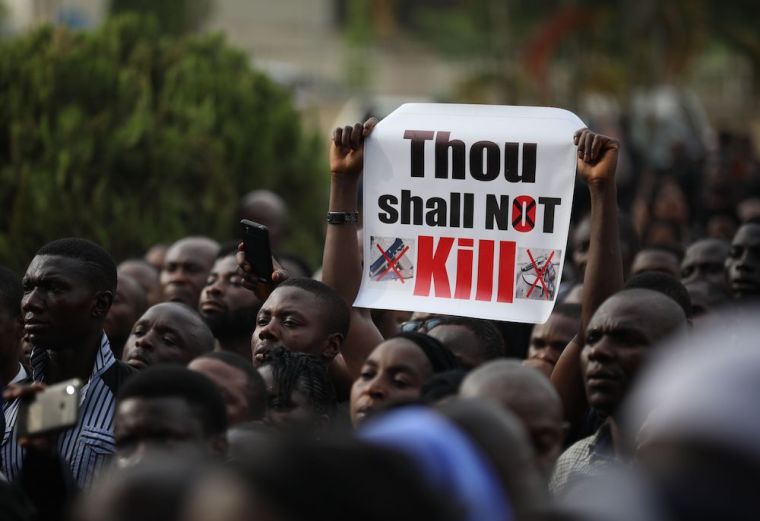
Nigeria: Christian lawyer receiving death threats for defending victims of Fulani attacks - Where are the Christian state leaders of the World to voice out for the BLOOD of their brethren!

  Nigeria: Christian lawyer in hiding after receiving death threats for defending victims of Fulani attacks Nigeria: Christian lawyer in hid...