Saturday, October 23, 2010

Taib’s Secret Bomoh – Exclusive!

Taib’s Secret Bomoh – Exclusive!

Saturday, October 23rd, 2010 GMT

By SARAWAK REPORT

Resources

Me, Dad and Ustaz ('teacher') on Uncle Taib's private jet - Yakub Tufail reveals the Bomoh's favoured family status on facebook!

Sarawak Report can reveal that the aging Chief Minister of Sarawak, Abdul Taib Mahmud, relies on a peronal witchdoctor, or so-called Bomoh, to make all key personal and government decisions!

The extraordinary state of affairs, which has remained a carefully guarded secret among his entourage for many years, has now been explained in detail by insiders.

“He will always consult the Bomoh before he makes an important decision, like which minister to hire or fire, or which investments to make”, one senior politician has confided.

Black magic!

Another member of the inner circle, linked closely to the family, also described how one particular Bomoh (see right) had a ‘Rasputin-like’ hold over the superstitious Chief Minister for many years. This Bomoh died two years ago, shortly after the death of Taib’s wife Laila, and the 73 year old leader is said to be frantically searching for a new supernatural advisor, who he can trust to take him through the up-coming election period.

“He hired an interim Bomoh” one source explained, “but he clearly was not satisfied, as he has been going around Indonesia looking for a more powerful magician and he has just engaged a new one!”.

Bomoh’s are practitioners of ‘black magic’ and are widely condemned for exploiting simple people, who do not have access to modern science and education. Taib Mahmud’s dependence on such guidance can only be judged as unhealthy and malign.

Taib consults ‘demons’ to fight his enemies

Not so effective? Taib's new Bomohs were publicly at work praying loudly in favour of Tufail Mahmud during a court case this year.

The devotion to such a primitive cult also seriously undermines the Chief Minister’s claims to be a progressive force in Sarawak. Perhaps even more damaging is the impact on his carefully cultivated reputation as a devout Muslim. The Muslim faith strictly bans any consultation of these pre-Islamic practitioners of magic and dark arts, who are considered to be bad and dangerous. The majority Christian population of Sarawak will be equally dismayed for similar reasons.

The tradition of Bomohs derives from ancient witchdoctor cults based in the Indian sub-continent and these individuals claim to gain their ‘supernatural powers’ through doing business with ‘fallen angels’ or ‘djins’ (demons). The Islamic faith recognises the existence of such evil spirits, however it forbids attempting to make contact with them.

Indeed, Muslim teachers warn that to seek favours from Djins is to bargain with evil forces and that eventually these forces will extract a terrible price. Moreover, people who do consult such spirits are considered to be engaging them to do unacceptable harm to others and to be attempting to effectively ‘cheat in life’. Taib is believed to have sought to mobilise these forces against his political enemies and the insiders believe he is now using them in his current battle against the Malaysian PM, Najib Razak (who would dearly like the tarnished kleptocrat to step down before the next election).

Dependent on soothsaying

'Ustaz' - real identity Abdul Rahman Hazrat from Pakistan

The dismayed insiders have told Sarawak Report that they would be inclined to laugh at an old man’s obsession if the implications were not so alarming, given his position. The Bomoh who held Taib enthralled for over 30 years was always known in inner circles as ’Ustaz’ (meaning teacher). He would frequently accompany the Chief Minister, who, to conceal his real role, would refer to him publicly as ‘My Uncle’ .

Ustaz liked to boast that his black magic ‘talent’ was given from God. He claimed to be able to foresee the future, heal the sick and, crucially, make the right political and economic decisions.

“An advisor or family member might query some decision” said one of our sources, “but if Taib replied that the Bomoh had ruled on it, then they knew there could be no further argument”.

The death of Ustaz and the loss of this advice over political and economic decisions is said to have put immense pressure on the Chief Minister as he enters his 30th year in power still determined to fight another election.

Rise of a part-time shop-keeper

Ustaz, whose real name was Abdul Rahman Hazrat, never spoke fluent Malay. He arrived from Pakistan in the 1960s and according to our sources was selling rings, spectacles and Islamic items in the town of Sibu at the time that Datuk Stephen Kalong Ningkan was the first Chief Minister. Hazrat claimed to be the disciple of a 130 year old teacher, who is allegedly still residing in his home country, Pakistan.

Taib, then 28 and State Minister for Natural Resources in Nignkan’s cabinet, was apparently introduced to to the stall-holder by the late Datuk Awang Hipni, a Melanau State Minister from Matu-Daro. It was after the ambitious young minister was sacked after failing to get along with Nignkan, that he is said to have first turned to the bomoh for advice.

Key advice

Bottles of Djinn - in this black magic 'exorcism' Bomoh's were reported to have captured evil spirits and imprisoned them in jars. The Chief Minister would appear to be a believer.

Ustaz later confided that he told Taib not to confront Ningkan directly but to lobby for a ministerial post at Federal level and from there to plot the downfall of Ningkan. This he did and soon Taib was appointed by Tunku Abdul Rahman as a Deputy Minister in the Federal Cabinet.

People in the know describe how it was with the advice of Ustaz that Taib used this position to topple Ningkan and eventually to succeed him. The strategy was to first place Penghulu Tawi Sli as a puppet CM, who then passed the position to Taib’s uncle. According to Ustaz, Tun Rahman, a Melanau by race (just 4% of the population) could not succeed Ningkan directly for fear of a revolt from the Dayak community (about 50%).

The plan succeeded, according to people who have talked with Ustaz. Tun Rahman was appointed Chief Minister in 1968 and passed the post to his nephew Taib in 1981, 29 years ago. From then onwards Taib relied heavily on the Bomoh and kept him as his personal advisor.

Member of the Taib household

Grace and Favour Residence - The Bomoh's home in Sibu

Proud of being ‘personal advisor’ to the Chief Minister, Ustaz whispered to his friends in Sibu that Taib made arrangements for him to enjoy a comfortable life. To hide the relationship he continued to base the soothsayer in Sibu, where the Chief Minister’s younger brother Tufail was tasked with taking care of his needs.

The guru was bought a bungalow on Bandong Road and enjoyed an allowance of over RM 10,000 a month, courtesy of a timber company, whose main shareholder is Tufail. He was also supplied with a car and a driver, free services and a shop house at Cross Road where he was able to sell Islamic religious items.

Insiders say that if anything further was needed it was Tufail’s job to sort it out. Tufail, unlike some of Taib’s other brothers, apparently shares the Chief Minister’s interest in Black Magic.

However, whenever Taib had to decide anything of importance he would summon Ustaz to Kuching. The guru would usually make use of the Government-funded private jet, which Taib keeps for his own use and even had a special bedroom put aside for him in the ground floor of Taib’s home in Demak Jaya, right next to the Chief Minister’s office.

The Bomoh was transported in the Government Cessna jet reserved for the Chief Minister - described by his nephew Yakub (son of brother Tufail) as the fastest business jet currently flying.

The Bomoh would often stay at Demak Jaya for nights at a time, say those in the know, and when he was being consulted he would always rise early in the morning (often 3am) and start a laborious ceremony of prayer and meditation as he sought the guidance of the Djins (evil, dead spirits). Unnervingly, Ustaz was frequently considered by those around the Chief Minister to be able to provide very astute guidance.

“He was able to provide an intelligent and objective perspective of events and situations”, explains the political insider, “but I don’t call it supernatural, I call it much-needed common sense!”

Meanwhile, the Bomoh also offered the support of his magical powers around others of Taib’s inner circle. He would intercede in cases of illness to ‘discover from the spirits’ whether the sick person’s ‘time had come’. If this was the case he would under-take to ‘buy a little more time’ from the devils, so they could enjoy some more life. Unsurprisingly, family members were always grateful for this intercession at a time of need.

“He was always kind” says one beneficiary, “I don’t think it was a negative, evil influence. He just used his magic to help people”.

Bomoh used magic to help BN!

Azimat - On Taib's instructions these 'magic charms' have to be carried by all BN candidates to make voters 'warm' to them!

However, the Bomoh, with the encouragement of Taib, was not above using his magic in elections as well. All BN candidates in Sarawak were handed special amulets or ‘azimats’, designed to be carried in their pockets on the election stomp. The azimats were supposed to have the magical effect of making people who met the BN politicians warm to them and support them. However, it can be noted that Taib has never failed to take the insurance of also offering large amounts of cash to prospective voters as well.

Similar azimats were also handed to family and insiders for other occasions, such as to help pass examinations and achieve wealth and success. For those who believe in such old superstitions, such favours could be construed as attempting to gain an unfair advantage to Taib and his supporters, which was clearly Taib’s own intention.

Falling out

However, this relationship which was so close for many years did not end happily. Sarawak Report has received further fascinating inside information detailing how Taib fell out with his advisor in recent years, culminating in the old man’s return to Pakistan shortly before his death as a broken man.

The fact that insiders have been breaking ranks to inform Sarawak Report of such negative issues is being regarded by many as a sign that the Chief Minister’s grip on his party is failing. Others of a more superstitious bent may consider that he has lost his magic touch!

Taib's Daughter Cheats S'wak Natives of their Land

Raziah – Protesters Jailed!

Friday, October 22nd, 2010 GMT

Resources

Numpang Suntai and some of the logs illegally chopped down by Quality Concrete

In a recent story Sarawak Report exposed the shocking attempt by the firm Quality Concrete to force Iban villagers to hand over their rights to 3,035 hectares of Native Customary Rights Lands in Sebangan for just MR 250 (US$ 80) per family.

The company, of which the Chief Minister’s sister Raziah is one of the Directors, is after the millions of dollars-worth of rare and valuable hardwood trees in the area. However the Ibans are refusing, saying they want to preserve their forest for future generations.

Now, the leading protesters named in that story have been thrown in jail on the pretext of a fire that broke out at Quality Concrete’s logging camp on Monday. There is no evidence about what happened, however ten local people were originally arrested and three have still not been released: these are Numpang Suntai, a retired worker for Shell; Nicholas Mujah, who runs Sadia, an NGO supporting Dayak rights and one of the local headmen, Tuai Rumah Sadon ak Ason.

There is no evidence against any of these men yet the political motives are clear. Both Suntai and Mujah have been helping the locals with their vocal campaign and they have supported villagers who carried out a blockade against illegal logging by the company in their territory. Yet neither were anywhere near the outbreak of the the fire and it is clear their arrests are purely a response to their legitimate protests on behalf of their community. The pair came to Simunjan local police station in answer to a request by the local police chief, DSP Choo Yin Kok, whose telephone number is 082 803779, Mobile : 019-8583016 and have not been released.

So who are the real criminals?

Staggering wealth - Razia and family, Tatler featured her dripping in wealth at a Monaco Party

There is no evidence that local people were behind the fire. Indeed, since Quality Concrete’s provisional licence to log the area runs out next month, the motivation on their side is arguably stronger in terms of a potential insurance pay out. Meanwhile, the logging camp itself remains illegal and Sarawak Report has documents showing that Quality Concrete has been banned by the Forest Department from carrying out further logging in the area until and unless the dispute is settled.

Therefore, Sarawak Report and several local and international NGOs are questioning on what grounds are these people being held?

Abuse of power

Behind this scandal lies the malign influence of Raziah Mahumd, one of the Directors of Quality Concrete. She is the sister of Chief Minister, Abdul Taib Mahmud, and she has like the rest of the family has built her vast fortune from exploiting her access to planning permits via her brother who controls them. The only reason for having Raziah on the board of Quality Concrete, which is otherwise owned by the Sibu-based Tiang family, is that it is through her that they will have got the permit.

Quality Concrete's Licence is due to expire November 29th!

In return Raziah and her brother Taib will get their sizeable cut of the profits. Timber industry insiders have testified to Sarawak Report in considerable detail how the system works and we estimate that the Chief Minister and his sister stand to make several hundred million ringgit out of the destruction of this area, which they are then planning to turn over to Oil Palm plantations.

Things have gone too far in Sarawak

The scandal of what is happening in Sebangan is a sign that the Mahmud family have lost all sense of reason and proportion in their continuing mismanagement and plunder of Sarawak. In this case Raziah and her brother have been caught with their fingers in the till, stealing what is not theirs. Their reaction has been to bring in the police to persecute those who are standing up to their corrupt practices.

Of course this is not the first time Sarawak’s ruling family has done any of these things, but their record is catching up with them and the glare of world publicity is on them. We are just one week after the Sibu river disaster which Taib’s own Deputy and ‘Chief Cheer-Leader’, James Masing acknowledged was a man-made catastrophe caused by illegal logging allowed by Taib’s regime – a key sign that the old man is losing his grip.

So who is acting illegally? This letter from the Director of Forests to Quality Concrete demanding they suspend activities in Sebangan until the dispute with locals is settled has been ignored by the company.

What is more, Sarawak Report’s original report on Raziah’s raid on Sebangan was networked across the globe to concerned groups and publications and received a huge response online. The issue of the Ibans of Sebangan has also sparked a campaign in the United States and their plight has become a symbol of the corruption and injustice of Taib’s government.

Tonight, a distraught Christina Suntai, Numpang’s sister in Florida, called Sarawak Report to say he and his innocent friends are still in jail. “My brother has never done anything wrong, he is totally honest, all he has ever tried to do in his life is good”, she explained. If only the same could be said for the current rulers of Sarawak!

Surely the Federal Government, which has charge of the police, must intervene in the name of good sense and prevent this abuse of power and symbolic example of rampant corruption in Sebangan? To allow innocent protesters, who are of high-standing in their communities, to remain in jail in such a public case can only reflect even more badly and counter-productively against Taib and his faltering grasp of reality.

Seven arrests in Sarawak (Malaysia) over logging dispute

By Bruno Manser Fonds

We have just received the news that the Malaysian police have arrested Nicholas Mujah, the Secretary General of the Sarawak Dayak Iban Association (SADIA) and six Iban villagers, including the headman of Kampung Bajong in Sebuyau, Sarawak.

Nicholas Mujah was assisting the native Iban community in Sebuyau in a native customary land dispute involving a company named Quality Concrete Holdings. Quality Concrete Holdings has been in the centre of the dispute after the Forest Department gave it a licence to carry out logging activities in 3,305 hectares of forests which Ibans from six longhouses claim to be their Native Customary Rights (NCR) land. Quality Concrete Holdings are linked to the family of Sarawak's extremely corrupt Chief Minister, Abdul Taib Mahmud. Taib's sister Roziah is a director and an important shareholder of Quality Concrete Holdings.

Mark Bujang, director of the Borneo Resources Institute Malaysia (BRIMAS) in Miri writes:

"When negotiations failed the Ibans have brought their case with the Police, the district and resident offices, the lands and surveys and the Forest department.

When all these failed, the natives since last Friday, 15th October have erected a blockade to stop the workers from the Royal Billion company encroaching into their native customary rights land.

They have also stopped a "tongkang" or barge from loading timber that has been extracted from the disputed area."

"Last Monday, 18th October a fire destroyed a block of two storey quarters occupied by timber workers, a store, six tractors, two logging trucks, a pick up and an excavator belonging to Royal Billion Sdn Bhd, a logging contractor contracted by Quality Concrete to extract timber in the area."

"Nicholas Mujah and 6 other villagers are currently being detained by the police at Simunjan Police Station. Last night 4 villagers were arrested which include a headman. They are Tuai Rumah Neli of Kpg. Bajong, Tinsi ak Bunda and 2 others. They are apparently being charged on allegation of mischief by fire.

A total of about 200 villagers gathered outside the police station in support of Nicholas Mujah and 6 other villagers that were arrested.

Lawyer, See Chee How is also at the police station."

The Bruno Manser Fund protests against this blatant case of non-respect of native rights by the local authorities and urges the Malaysian auithorities to release all arrested persons immediately and to stop all logging activities on the affected communities' lands.

---------------------------------------------

Please help us to campaign for the immediate release of the arrested forest campaigners in Sarawak.

According to our latest information, out of ten people arrested over a fire at a timber camp, seven have been released while three were remanded until Monday, Nicholas Mujah Ason, Numpang ak Suntai and Tuai Rumah Sadon ak Ason.

The villagers are saying that they were half way down the hill from the timber camp where the fire started; and Nicholas Mujah was in Pulau Bruit, more than 400 km away when the incident happened.

The local police chief's name is DSP Choo Yin Kok. Tel number : +6082 803779, Mobile : +6-019-8583016

International attention to this case could help raise pressure on the local authorities. If you have time, please give Mr. Choo a polite call and ask him for the immediate release of Nicholas, Numpang and Sadon.

Sunday, October 17, 2010

Malaysian Plantation Robbing Natives' Land

A short-lived joy in Baram, Sarawak

IN March 2010, indigenous peoples from Long Teran Kanan, Baram in Sarawak were overjoyed when they won a 13-year legal battle against IOI Pelita Plantation. The Miri High Court recognised the Kayan and Kenyah communities’ native customary rights over the disputed land.

However, their joy was short-lived. IOI Pelita Plantation filed an appeal against the High Court ruling in April 2010. A date has yet to be fixed.

The Nut Graph visited the village in August 2010 and found that despite the ongoing legal battle, the oil palm corporation continues to encroach upon the villagers’ native customary land, threatening their livelihoods as well as their last clean water source.

IOI Pelita Plantation

IOI Pelita Plantation estate office

Embattled community

After the High Court ruling, IOI did not stop its operations on the disputed land. It explained this in its press release soon after the High Court judgment. The corporation said the court had not granted any injunctions sought by the natives to restrain the company from continuing its operations on the disputed land.

However, the villagers’ lawyer, Harrison Ngau Laing, points out that the Miri High Court had declared the two provisional leases issued by the state to the company “null and void”. This means that the disputed land still belongs to the villagers. On their lawyer’s advice, the villagers have lodged a police report against the company for continuing to trespass on their land.

“Until today, IOI (Pelita Plantation) has not applied for a stay of execution of the High Court’s decision. Note that an appeal does not operate as a stay of execution,” Harrison tells The Nut Graph during the visit.

In a response to The Nut Graph’s photo gallery piece on the land dispute, IOI Corporation Bhd justified its continued operations on the basis that the High Court had disallowed the indigenous peoples’ claim for a declaratory order to cancel the leases and for vacant possession of the lands to be returned to the natives.

IOI further stated that it was willing to compensate the villagers in accordance with the High Court’s ruling. The company said it was still waiting to for Harrison to provide them with information on the assessment of damages.

Harrison, however, believes that IOI should first stop its activities on the disputed land “if it is serious and sincere in resolving its conflict with the villagers”.

Right to livelihood violated

In the meantime, the Kayan and Kenyah peoples have to put up with their paradise lost. It’s not a question of compensation; it was never their intention to give up their ancestral land to begin with.

Villager Anyi Jau, 57, recalls the day in 1996 when the land of his ancestors was ravaged. Returning from work at a logging camp, he was shocked to find that everything on his ancestral land – crops he planted and structures he had built – was gone.

Anyi Jau (right) and couple Kalang Anyi, 53, and Payajok, 50

Anyi Jau (right) and couple Kalang Anyi, 53, and Payajok, 50

“Pokok buah-buahan, padi dan pondok-pondok [saya] semua habis ditolak. Mereka bagi saya RM400 sehektar sebagai sagu hati … Tapi jika ikut hati, saya memang tak mau jual kerana tanah tu tanah warisan,” Anyi tells The Nut Graph.

Bulldozers sent in by then Rinwood Pelita Plantation (IOI Group only took over the plantation in 2006 and inherited the court case) had destroyed everything. The villagers were outraged and many suffered significant loss of income.

Unlike Anyi, some did not receive any compensation for their lost land and destroyed crops and properties from the company. This led to the suit, filed in 1997, by four Kayans representing 92 families from Long Teran Kanan against Rinwood Pelita Plantation. Among the four is the current acting Tuai Rumah (village chief), Lah Anyie, 46.

“[Apart from each villager’s individual lands], Rinwood also destroyed our pemakai menua (communal land).

“That was [like] our mini supermarket; we could get fish, meat, vegetables, medicine, wood, rotan … everything there. Now we’ve to buy everything from outside,” Lah Anyie says.

He adds that IOI Pelita Plantation has offered to hire the villagers to work as estate labourers for RM12 to RM15 per day. But few villagers are willing due to the low pay. Even Lah Anyie pays more to villagers who work in his orchard, at RM25 to RM40 per day.

IOI, however, insists that its “wage rate is quite attractive in the industry”, a representative from its headquarters in Putrajaya tells The Nut Graph in a meeting on 4 Oct 2010. This representative has declined to be named due to company policy that only permits on-the-record statements by senior management.

Right to clean water

The representative also refutes claims by the villagers that chemicals used in the plantation have polluted one of their rivers.

Sungai Tegai, which villagers used for drinking and bathing when they were out working in their orchards, is now polluted, the villagers say. They blame company workers, whom they have seen mixing weedkiller next to the riverbank using water from the river.

“We found dead fish in the river, so we thought something must be wrong and stopped using it,” Lah Anyie claims.

Acting Tuai Rumah Lah Anyie at the dam at Sungai Nunok, explaining how plantation activities are affecting their water catchment area

Acting Tuai Rumah Lah Anyie at the dam at Sungai Nunok, explaining how plantation activities are affecting their water catchment area

The IOI representative says water samples are collected from rivers in the estate every three months, and the results so far show no contamination. But on the ground, plantation assistant manager Ellevenson William Dueed does not appear surprised when The Nut Graph inquires about the contamination. “[Workers] may have cut corners [in this case]; I will need to check,” he says.

Another river, Sungai Tinjar, is located just beside the village but has been contaminated due to logging activities upstream. The last available water source for Long Teran Kanan villagers is also threatened by plantation activities.

“Our pipes are often blocked because of the gravel and sand that has entered and contaminated the river. It’s revolting because we use this water to cook and drink,” Lah Anyie says.

The community raised the matter with IOI Pelita Plantation in a November 2009 meeting. However, the company has not halted its activities at the river’s water catchment area.

Wrong development concept?

Rinwood Pelita Plantation was a joint-venture company set up in 1996 between Rinwood and Sarawak’s Land Custody and Development Authority (Pelita). In 2006, IOI acquired 70% of Rinwood’s shares, while Pelita held the remaining 30%.

Despite the fact that the Kayan and Kenyah community settled there in the 1960s, Pelita considered their land state land. Pelita issued two provisional leases to Rinwood to develop the areas into oil palm plantation without consulting the community.

Harrison points out that the state has been arbitrary in recognising native customary rights over land. “When Petronas wanted to build a pipeline across this same land, the community was compensated accordingly. So why the double standard?” he asks.

Additionally, Long Teran Kanan’s case bears many resemblances to other land conflicts that have arisen out of Konsep Baru. Introduced by the state in the 1990s, Konsep Baru was supposed to promote commercial development of “idle” native customary lands. Under this scheme, companies would engage in joint ventures with native landowners and the state.

However, in practice, native landowners are rarely consulted or informed before the state leases out their native customary land to the companies. Hence, most native landowners only find out when the bulldozers roll in.

Longhouse in Long Teran Kanan

Longhouse in Long Teran Kanan

For the native landowners, the only recourse for justice is the courts, as many feel it is pointless to turn to politicians or government agencies for help. “We have complained to our YBs and [they] would say, ‘Okay, I’ll do something’, but nothing [ever] happens,” Lah Anyie says.

Stalemate

IOI is distancing itself from any past violations by Rinwood. As far as the corporation is concerned, it has adhered to the principles and criteria of the Roundtable on Sustainable Palm Oil (RSPO) to respect native customary rights and acquire land only with “free, prior and informed consent of local communities”.

The IOI representative from Putrajaya tells The Nut Graph that they have always left alone the land already cultivated by the community. Many of the alleged violations, including the bulldozing of crops and structures belonging to the Kayan and Kenyah peoples, may have been committed by IOI’s predecessor, the representative claims.

But this difference may mean little to the people of Long Teran Kanan, whose lives are tied to their land – the loss of which is irreplaceable.

Disclosure: Gan Pei Ling visited Long Teran Kanan from 21 to 24 Aug 2010 with representatives from the Palm Oil Monitoring Initiative, which includes Tenaganita, Grassroots Consulting, the Sarawak Indigenous Lawyers’ Alliance, and the Sarawak Dayak Iban Association. Trip expenses were borne by The Nut Graph in the interest of editorial independence.

The Nut Graph needs your support


Monday, September 27, 2010

Malaysia in tepid investment - World Bank

Malaysia an ‘extreme’ example of tepid investment, says World Bank

September 28, 2010
The World Bank is supportive of the reforms Najib intends to carry out.
KUALA LUMPUR, Sept 28 — Malaysia is lacking in investment in human and physical capital leading to domestic savings greatly exceeding domestic investment, said a World Bank report.

The bank noted that Malaysia, like its fellow middle-income neighbours Indonesia, Thailand and Philippines, is trying to move out of the middle-income trap but said it requires investment in infrastructure, equipment, education and skills in levels far exceeding what they are currently experiencing, which is well short of the Republic of Korea, Japan, and Singapore when they were at similar per capita income levels, when they were at the same development stage.

“The slowdown in investment does not stem from a lack of savings—indeed, in all these countries, domestic saving exceeds domestic investment, resulting in external current account surpluses,” noted the bank in its report on economic policy in the developing world titled The Day After Tomorrow.

“An extreme example is Malaysia, where the current account surplus was 17 per cent of GDP in 2008 and 2009.”

It added that rigidities in the labour market and entry barriers tend to discourage private investors in Malaysia.

The bank however commended the Najib administration’s New Economic Model (NEM) with its emphasis on private sector led growth, innovation, removal of labour market restrictions and focus on talent, saying that it is representative of reforms that the nation requires. The prime minister had also earlier managed to push through several reforms such as liberalising the financial sector and selected services sub-sectors.

Malaysia has also recently embarked on a slew of private sector driven projects under its Economic Transformation Programme (ETP) that would require private funds to the tune of USD266 billion (RM822 billion).

The ETP aims to roughly triple gross national income (GNI) in the next 10 years.

Turning around the sentiment of private investors however will be one of the biggest challenges faced by the present government.

Many investors are mindful of the constraints in Malaysia including the lack of a world class workforce and education system, policy inconsistencies, bureaucratic red tape and the widespread acknowledgement that four decades of affirmative action has affected the country’s competitiveness.

A recent report by the Economist Intelligence Unit also noted that political resistance has delayed radical reform measures required to restructure the economy to a high income one.

A recent report by CIMB citing government statistics showed that Malaysians are investing more money abroad. The flow of money heading out in the second quarter saw a sharp increase to RM6.2 billion from the first quarter of this year when RM3.8 billion was recorded as direct investment abroad.

CEO of government think tank Pemandu, Datuk Seri Idris Jala appeared to acknowledge that private investment is largely a game of confidence.

“If there is no hope in the future, there is no power in the present,” he said recently.

What will be closely watched is whether the first batch of seven ETP. projects will commence soon as that would likely have a knock-on effect on investor confidence.

Second Finance Minister Datuk Seri Ahmad Husni Hanadzlah said last week that if the seven ETP projects which are said to have named and serious investors, could take off next year, it would “give confidence”.

Sunday, September 26, 2010

Another Indigenous People Land about to Grabbed by Taib family

Raziah Grabs Multi-Million Dollar Forest for just RM 250!

Saturday, September 25th, 2010 GMT

Victims of the Land Grab - Ibans of Kampong Ensika

In an act of breathtaking meanness and greed the multi-billionaire Taib family are seeking to deprive impoverished Ibans of one of Sarawak’s last remaining hardwood forests, for a paltry compensation of just RM250 per family.

Meanwhile, Sarawak Report has received exclusive new leaks which indicate that the Chief Minister himself stands to personally profit by a million times that amount (an estimated RM250,000,00) in corrupt backhanders from the deal.

Raziah Mahmud and Quality Concrete Holdings

This latest illegal raid on Native Customary Rights Land is being carried out by Quality Concrete Holdings Berhad, a company part owned and directed by the Chief Minister’s own sister, Raziah Mahmud. The Taibs, one of the richest families in Asia, have already started harvesting the timber, which is worth millions of US dollars, even though the majority of the villagers are refusing to accept the deal.

“We have been threatened that if we oppose this claim we are going against the government and opposing development” explained one protester, “but why does the government act like a common thief in this case and how much development can we achieve for RM 250?”.

Already driving into the forest without permission

The threatened area is a small range of hills near Sebangan not far from Kuching, consisting of 3,305 hectares of forest. The surrounding region has already been devastated by state-sponsored logging promoted by the Taibs in the 80s and 90s.

However until now it was not considered economic to tackle the raised ground, which has been farmed and hunted for generations by 16 villages of Iban dwellers.

The villagers explain that the area is carpeted by hundreds of thousands of tall trees, some of it valuable primary jungle containing hardwoods that are now painfully scarce. The Secretary General of the Sarawak Dayak Iban Association (SADIA) Nicholas Mujah, who comes from the community, says that there are up to 700 tons of Belian, Meranti, Bulyan, Selangan, Kapur, Kempas, Tekam, Resak, Lon, Penyau, Ruan and Engkaban available per hectare. These all command top prices in the world market, although the logging of such rare timber is now internationally condemned.

The area is also a refuge for some of Sarawak’s remaining wildlife and birdlife, much of which has been wiped out by the Taibs over the past 30 years.

Corruption and conflict of interest

Conveniently on the Board - Raziah Mahmud, Taib's sister

The Iban owners of the forest say they are happy to conserve the wood for future generations and to conduct sustainable logging for their needs. However, the aging Chief Minister, who has already earned billions out of corrupt logging deals seems to have been unable to resist the prospect of grabbing more money by cutting it all down.

In this case, like so many others, he has used a relative, his sister Raziah Mahmud, to conduct the plunder. Raziah is a shareholder and paid Non-Executive Director of Quality Concrete Holdings, a public company largely owned by the family of Tiang Ming Sing and Tiang Ming Kok (the Chairman and Managing Director). She is therefore directly profiting from her connections with the Chief Minister, who hands out all timber licences.

The CM’s cut will be at least MR250 million - Exclusive new Revelations

However, following new leaks, Sarawak Report is now able to further reveal an even more shocking form of corruption involved in the deal. Top timber company insiders, have exclusively confided to Sarawak Report that before issuing any timber licence the Chief Minister always demands an extra secret cut, to be paid upfront into one of his offshore bank accounts.

MR250 million? Not bad, even for a multi-billionaire Chief Minister!

The insiders say that Taib traditionally demands a rate of RM 100 per ton of timber. However, in this latest case the sum is likely to be substantially larger given the value of the hardwoods at the Sebangan reserve.

According to the whistle-blowers, the Chief Minister calculates his cut by getting State Forest Department officials to assess how much timber is available in each concession.

So, if the 3,305 hectare Sebangan forest contains 700 tons of wood per hectare, this would mean that, at conservative estimates, Taib will have bagged just under 250 million ringgit from issuing the licence. That is well over $80 million dollars at current exchange rates and is almost exactly a million times the amount being offered to the Iban families who rightfully own the land!

Sarawak Report would therefore like to ask Quality Concrete to confirm if they have yet made such an up front payment or if they are paying part up front and part later, which is sometimes the arrangement, or whether they are claiming that on this occasion they have been for some reason let off the payment?

Robbing his people blind

Simple people robbed of their heritage

Such miserable deals have been the pattern by which the Chief Minister has deprived numerous communities in Sarawak of billions and billions of ringgit-worth of timber and made himself one of the richest men in Asia. Instead of going into promised development the money has gone into Taib’s foreign bank accounts, leaving the people of Sarawak among the poorest in Malaysia, despite their rich natural resources.

Strong-arm tactics – lies and thugs

In this latest case the Taibs are again attempting to abuse their control of state officials and adopting strong-arm tactics to force the unwilling villagers to hand over their forest, firstly through misrepresenting the terms of their licence.

The truth - Raziah's conditional licence expires in two months!

Quality Concrete have in truth, only been issued a conditional year-long Occupation Certificate to log the timber, for the very reason that this is Native Customary Rights (NCR) Land.

This certificate has been issued under Section B of the Forest Ordinance, which specifically means that Quality Concrete need to achieve the consent of the Iban landowners before commencing any logging.

However, Raziah and her business cronies have of course done no such thing, because they know that such consent would either be withheld or would only come at a reasonable price for the land! They have instead sought to imply that they are fully licenced to strip the forest.

No warning and no permission asked

”Nobody warned or consulted us about anything” explains Sadun Ason, the Headman of Kampong Ensika, one of the affected communities. “The first I knew of it was when a villager called me to say he had seen logging equipment being shipped up river by boat on 11th July. We then immediately called the Pengulu, who astonishingly said he knew all about it and told us that there is nothing we can do to protest as the whole matter is perfectly legal and we have no rights!”

Traditional meeting - community representatives discuss the crisis

The 16 villages involved are rightly suspicious of this Pengulu. Taib undermined democracy in when he removed the right of longhouses to elect their own headmen and Pengulus and started to appoint these ‘representatives’ himself.

He pays them a miserable monthly salary to keep them loyal, nevertheless, these characters usually still come from the local community and are accepted by the residents.

However, in this case a new Pengulu was appointed a few weeks before the issuing of Razia’s logging licence. He is a PBB member from an outside town. The headmen are naturally furious he kept them in the dark about Quality Concrete’s plans and the previous Pengulu has also testified against such behaviour and joined their protest.

“If there is anything that relates to the joint ownership of the forest the Pengulu should discuss the matter with the headmen and likewise the headmen would talk to their villagers. All these resources are shared resources and it is not right for the Pengulu to make a decision, especially such an important decision on his own”, says Ason emphatically. “Rightfully the Pengulu and headmen should be the ones to protect the forest, but we end up fighting him”.

Deceitful tactics by the loggers and their official backers

Coming down - logging of valuable wood has started

The villagers have tried to blockade the site and have demanded proper information and paper-work from Quality Concrete, but Raziah and her co-directors have been characteristically unforthcoming. Outrageously they have also started driving a road into the territory and harvesting valuable timber in the process.

At a meeting organised by the police on 2nd July, officials from the Forestry Department and Land Survey Department showed their bias by meeting first separately with the representatives of Quality Concrete and their lawyers along with the suspect Pengulu.

The officials then came out and claimed to the villagers that the land was not gazetted and claimed there was no evidence the area was NCR land. However, Sarawak Report has obtained evidence proving this claim was untrue. In fact the Land Registry’s own records show that the land has been gazetted since 1956 and is indeed Native Customary Rights Land. The licence Quality Concrete has bee given is subject to any NCR claims. Meanwhile, internal documents from the Forestry Department also show that officials have now instructed Quality Concrete not to encroach on the vast majority of the area contained in the provisional licence unless and until the dispute has been settled.

Gazetted since 1956 - this proof of NCR status came from the Land Registry!

Sarawak Report has copies of all these documents, however in typical fashion the officials on the ground, working with Raziah Taib and Quality Concrete and their lawyers have attempted to conceal these facts from the villagers.

Bullying into submission

Meanwhile the timber company and Pengulu have been working hard to browbeat and divide the community into submission. They have gone around all the longhouses offering MR25o ‘compensation payment’ to each family prepared to sign away their rights to the forest and MR800 to each headman. This may be a laughable sum, but Taib has kept his people financially poor for a very good reason – it makes them easier to rob of their natural wealth.

On 13th August a group of 11 villagers including three of the 16 headmen were transported in Quality Concrete’s own vehicles to Sibu, where they were given a reception and dinner and then asked to sign documents in the absence of any legal representative. They were not given copies of the documents to bring back, but they were told that they have now legally signed away their rights to the forest.

Dirt poor - this family took the money

These headmen have now gone round other long houses and persuaded a number of the desperately poor villagers that, since they have no choice in the matter (not true), they had better take what money is available to them.

A minority of the villagers have now been persuaded to go to the nearby town of Sebuyau and sign away their claims for a mere MR250. They had no legal representative and have been offered no copies of the documents they signed – most are illiterate.

“The worst thing about it is that it has divided the villages in such a terrible way”, says Numpang Suntai who has been helping coordinate the protests. “Some are so browbeaten and poor they feel they must accept the money, but the others know that in the long-term the consequences will be terrible for us. We look at neighbouring areas where this has happened and we know we will suffer. We won’t have any wood, our land will be taken, the wildlife will be gone, the water of the river will be affected and the fish will all die. We will be hungry. Our life is tough and we have no real income, so we depend on the forest”.

Aware of the consequences - Numpang Suntai, local campaigner

Numpang dismisses the idea that there might be jobs and development. “There will be no jobs at all, they use Indonesians to cut down the forest and Indonesians to work on the palm plantations. They only offer MR7 a day to work on palm plantations and we can’t live on that. The Indonesians find it worth it, because of the exchange rate for them”.

A fit leader for Sarawak?

Taib of course believes that he will triumph in this matter. The fight for Sebangan’s final forest has reached a critical stage, which he, his sister and their timber company collaborators have experienced many times before. They have all the finance, the official backing and of course, access to intimidation as well.

The villagers are already fearfully expecting the arrival of the notorious logging company ‘thugs’, the strongmen who so often come to intimidate local communities who hold out against them. Meanwhile, the Pengulu and the logging company legal teams are misleadingly informing the protesters that because some people have now signed it will be impossible to stop the logging.

Campaigning on landrights - PKR's office in Kuching

However, signs are that people are waking up to the Chief Minister, Abdul Taib Mahmud. It will be interesting to see whether the new information revealing the true extent of Taib’s personal profit from this raid - his MR250 million cut - will alter the dynamics of this particular forest battle.

Sarawak Report will also be forwarding the inside leaks from the Land Survey Department and Forestry Department to the protestors’ newly acquired legal team, headed by Baru Bian in Kuching.

Baru, who is Sarawak’s top human rights lawyer and the PKR leader in the state, has started to win significant court victories against Taib in the local and federal courts .

Agent for Change - Baru in campaigning dress at his desk

Taib’s last grasp?

This scandalous new case will join over 200 other native land rights cases on his desk, all of which directly challenge the Taib family’s devastating plunder of the state.

Most importantly, the Chief Minister will soon face the electorate with a record that no politician on earth would wish to have to defend.

Friday, September 17, 2010

Another Orang Asli church to be demolished

I received the following media release, background facts, copies of letters and photographs from Suaram by e-mail about an hour ago.

__________________________________

Media Release

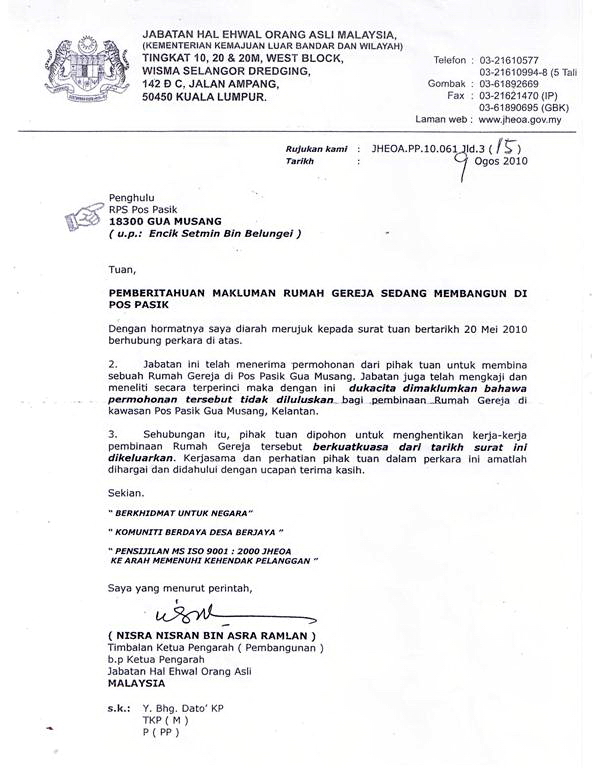
The Christians in the Temiar village of Pos Pasik, about 70 km northeast of Gua Musang Kelantan, have been told by the Department of Orang Asli Affairs (JHEOA) that they have no permission to build a church on their land.

On 20 May 2010, the village head wrote to the Director-General of the JHEOA to inform him of their plan to build the church in their village, half of whom have converted to Christianity in recent years.

However, on 9 August 2010, the Deputy Director-General, writing on behalf of the D-G, replied that their “application” to build the church had been rejected and the community was asked to stop work on the building immediately.


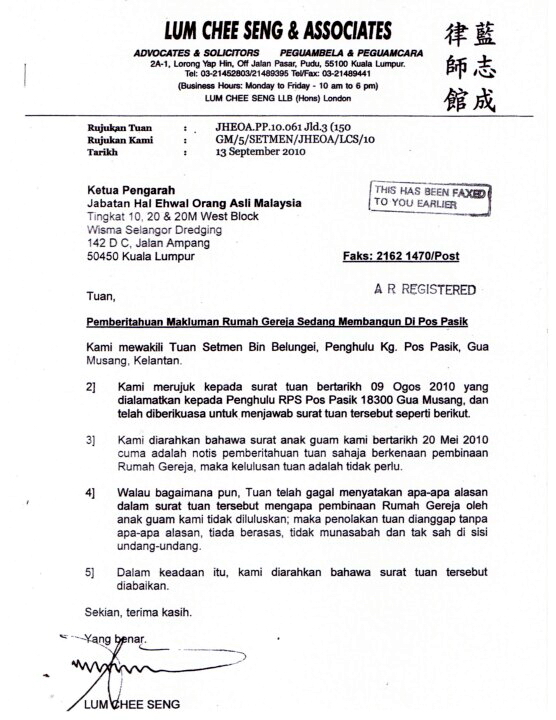
The Orang Asli are not happy with this answer as they did not seek permission from the JHEOA. They merely exercised courtesy to inform them of their plans. The Orang Asli of Pos Pasik consider it their right to build such a structure on their land, in accordance with the Constitution.

The lawyer representing the Temiar headman has recently written to the D-G informing him that the department’s permission was not being sought. He also sought the reasons for the rejection of the church building.


If the church is demolished or stopped, it will be the second Orang Asli church in the state of Kelantan (and no less than 5 in the peninsular altogether) that have been demolished by the authorities on the basis of various excuses, including that the Orang Asli do not have rights to the land concerned.

But it is evident that the issue is religion-related as other structures, including suraus, have been build on such lands without any issue.

But as land is a state matter, the Temiars of Pos Pasik are seeking the intervention of the Menteri Besar of Kelantan in this matter.

For further details, please contact: Pastor Moses Soo – 012 3255678

_______________________________

Background facts

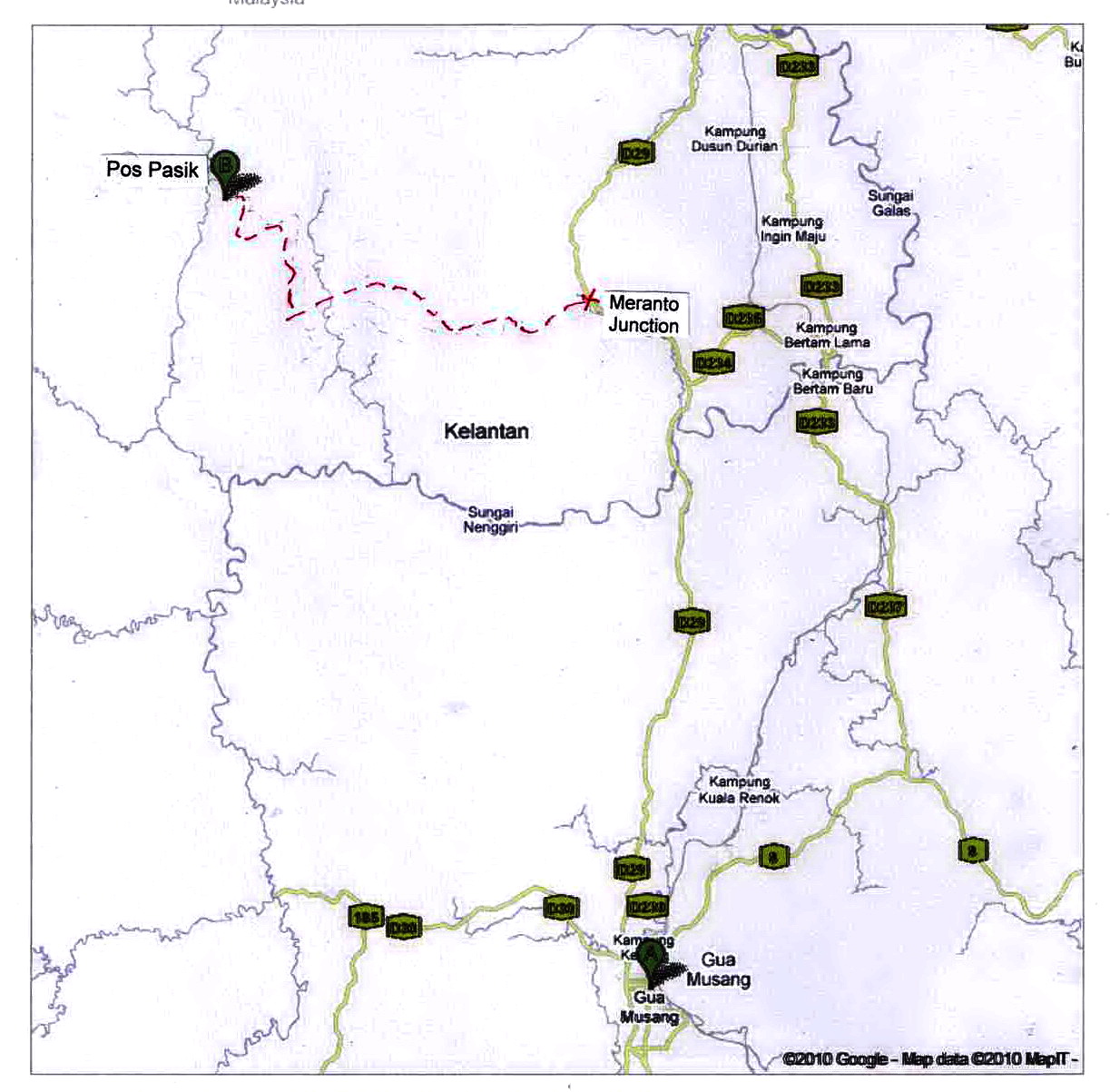
Pos Pasik is situated about 70 km northeast of Guas Musang in Kelantan. It is in forested area at the foot of the Titiwangsa Range. The post includes the villages of Kg Pasik, Kg Ayung, Kg Bayor and Kg Serai.

The Orang Asli here are of the Temiar ethnic group with a few being Jahai. It is situated on both sides of Sungei Jenera, with a population of over 600. The villagers are connected to the main road at Meranto by a logging track. Pos Pasik is only reachable in a proper 4 wheel-drive vehicle and takes about 2-3 hours of traveling time.

On 3 December 2001, 297 villagers of Pos Pasik were baptized as Christians, including the two Penghulu (headmen). A bamboo church was then built in the old village across the river (Sungei Jenera).

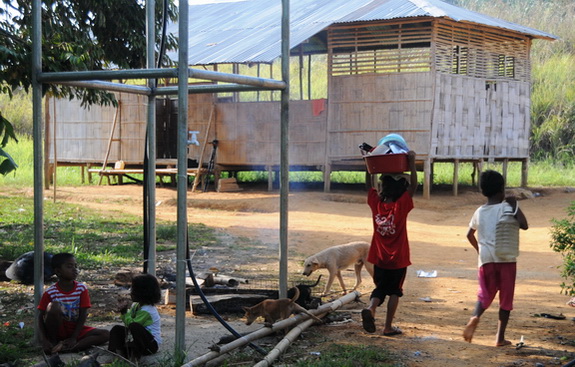
In the late afternoon of 19 December 2004, the Sungei Jenera overflowed its banks, rising to a height of 30 feet above the normal water level of the river. The bamboo houses of the Temiar by the river were all washed away. So too the church. By 2006, many of the villagers shifted to the current side of the river and the bamboo church was relocated there as well.

Currently, a total of 530 villagers of Pos Pasik have converted to Christianity but quite a number have left Pos Pasik to work in other areas.

In 2008, the government provided brick houses and agricultural plots for the communities there. The road has also been improved though it is almost inaccessible during the rainy season.

In late 2009, the Christians requested the pastor from the Gospel to the Poor church to help them build a brick/concrete church since most of their houses are already made of brick. This is to replace the dilapidated bamboo church.

Existing church constructed from bamboo

By April 2010, they started clearing the land of rubber trees belonging to one of the villagers. At one of their meetings, it was decided that the headman should update JHEOA of the latest development by informing them through the mail.

Work then began on the church construction. The workers were all Orang Asli volunteers with the necessary materials being raised through church donations.

The new church under construction

During this period of construction, they had a lot of uninvited visitors especially those from the religious bodies.

Posted by Haris Ibrahim
Filed in Nation in Distress

Nigeria: Christian lawyer receiving death threats for defending victims of Fulani attacks - Where are the Christian state leaders of the World to voice out for the BLOOD of their brethren!

  Nigeria: Christian lawyer in hiding after receiving death threats for defending victims of Fulani attacks Nigeria: Christian lawyer in hid...