Thursday, January 16, 2014

How to Make Sense of Your Cholesterol Levels

How to Make Sense of Your Cholesterol Levels Infographic
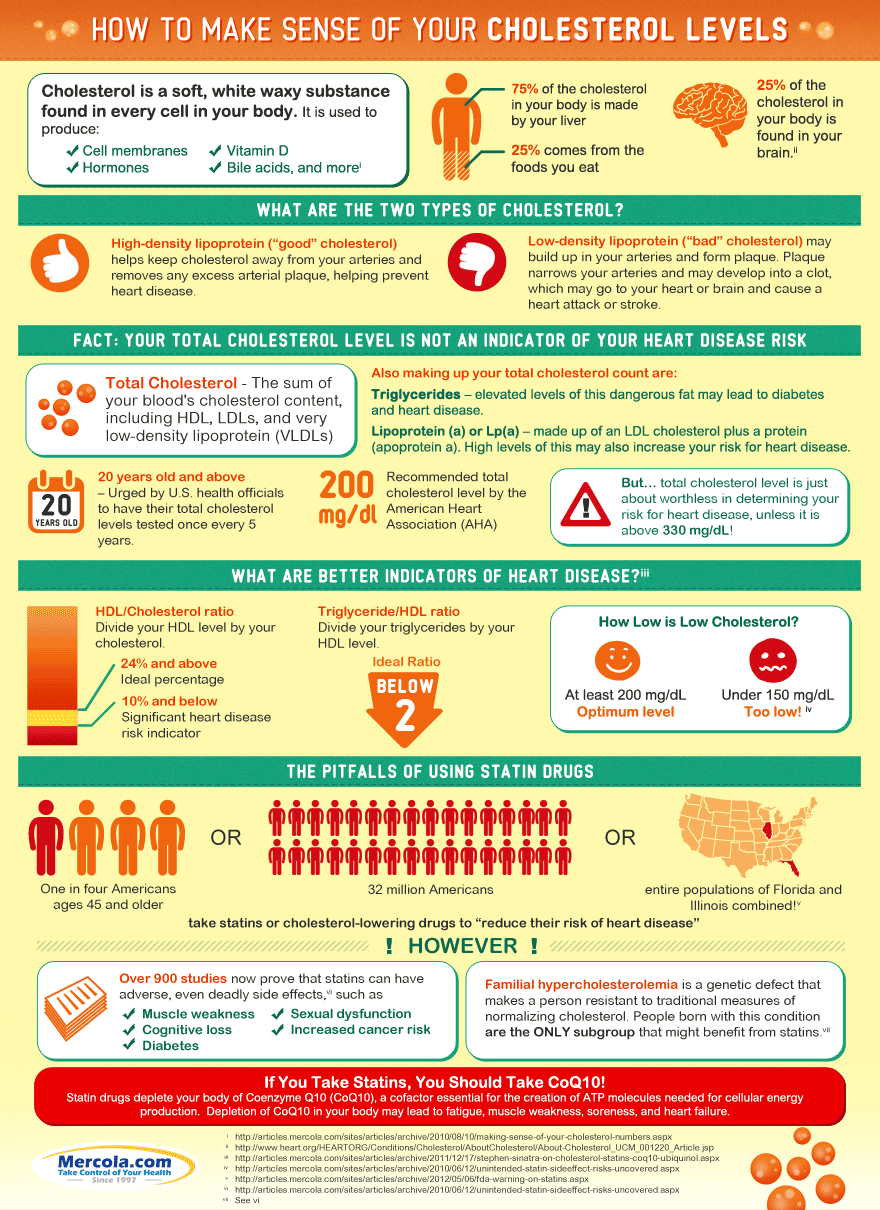
  cholesterol levels infographic


Discover More...

Understanding Cholesterol: How to Stay Within the Healthy Range

High cholesterol has been associated with poor health and an increased risk of heart disease for the last two decades. This idea immediately spawned myths about saturated fats, which demonized certain categories of food, like eggs and healthy oils. Most physicians will advise you to keep your cholesterol levels as low as possible, or else suffer serious complications.
But did you know that high cholesterol is not necessarily a precursor to poor health nor is it an indicator of heart disease?
In my years of practice, I have seen people whose total cholesterol levels were over 250 but had a low risk of developing heart disease. I have also encountered patients who were highly at risk for heart disease despite low cholesterol levels (under 200).
Conventional doctors neglect to tell you the truth: your body NEEDS cholesterol. And there are far better indicators of your heart health than just your total cholesterol level.

Back to Basics: What is the Purpose of Cholesterol?

About 75 percent of the cholesterol in your body is produced in your liver, while the other 25 percent is obtained from the foods you eat. This soft, waxy substance is essential for the production of:
  • Cell membranes
  • Hormones
  • Bile acids (for fat metabolism)
  • Vitamin D
Cholesterol also contributes to the formation of your memories and is crucial for your neurological function. Cholesterol also affects the formation of serotonin, a hormone that is involved in your mood regulation.
Studies have found that people with insufficient levels of cholesterol have a higher chance of developing depression and suicidal thoughts, while others may experience an increased capacity for violence and aggression. In extreme cases, low cholesterol can raise your risk of cancer and Parkinson’s disease.
A rise in cholesterol levels, on the other hand, occurs in response to damaged cells. A high amount of this substance in your bloodstream just proves that your body is working to repair or create new cells.

Statins: A Drug That's Actually Bad for You

Having elevated levels of cholesterol (unless you are suffering from a genetic defect called familial hypercholesterolemia) is not a disease that requires statins, yet millions are taking them as we speak. It is unfortunate that Americans are led to believe that this class of cholesterol-lowering drugs is the answer to normalizing cholesterol levels, when there over 900 studies documenting their adverse effects.
For instance, statins also deplete your CoQ10 levels. CoQ10 or Coenzyme Q10 is a substance that plays a crucial role in the creation of your ATP molecules needed for cellular energy production. Other than the side effects brought by statins, CoQ10 deficiency can also yield to a number of complications, including heart failure.
Unfortunately, conventional doctors oftentimes immediately base judgment on numbers and prescribe dangerous statins, which ironically puts your heart health at risk.

It's Time to Step Away from Cholesterol Myths

Cholesterol shouldn't be feared to the point that you need toxic drugs to suppress it. Rather, the key is to understand how cholesterol works to know how to stay within an optimal range. I urge you to read my infographic How to Make Sense of Your Cholesterol Levels to discover this and how you can "read" your cholesterol levels to help gauge  your risk of heart disease.
It's time to shatter the myths surrounding cholesterol and statins! Share this infographic with your friends and family, and help them take control of their health.

How Probiotics May Aid Your Weight Management

How Probiotics May Aid Your Weight Management


By Dr. Mercola
Your gastrointestinal tract houses some 100 trillion bacteria—about two to three pounds worth. In all, the bacteria outnumber your body’s cells by about 10 to 1.
Your intestinal bacteria are part of your immune system, and researchers are discovering that microbes of all kinds play instrumental roles in countless areas of your health. For example, beneficial bacteria, also known as probiotics, have been shown to:
Beneficial bacteria also control the growth of disease-causing bacteria by competing for nutrition and attachment sites in your colon. This is of immense importance, as pathogenic bacteria and other less beneficial microbes can wreak havoc with your health if they gain the upper hand. It can also affect your weight, as you’ll see below.
For all of these reasons, and more, I always recommend a diet rich in whole, unprocessed foods along with cultured or fermented foods. A high-quality probiotic supplement can also be a helpful ally to restore healthful balance to your microbiotia—especially when taking antibiotics.

The Diet-Bacteria-Weight Connection

Bacterial imbalance in your gut can be made worse by processed foods and foods that have been pasteurized or sterilized. Other factors affecting your gut flora include where you live, your age, your stress level, and any health issues you may have. Like processed foods, sugar also promotes the growth of disease-causing yeasts and fungi.
Symptoms of a yeast (candida) overgrowth include fatigue, depression, irritability, headaches, problems concentrating, muscle weakness, recurrent vaginal and urinary tract infections, athlete's foot, jock itch, persistent heartburn, indigestion, constipation, swollen joints, nasal congestion, and sore throat.1
In case you don’t have reason enough yet to re-evaluate your sugar and fructose intake, here’s another twist in the sugar-obesity connection: researchers have discovered a difference in gut bacteria between the overweight and those of normal weight.2
In the obese, a bacterial strain known as firmicutes is found in much greater abundance than in leaner individuals. In those of normal weight, thebacteroidetes strain is in greater supply.
The firmicutes bacteria appear to be much better than the bacteroidetes strain at turning calories from complex sugars into fat. As those who are overweight begin to slim down, the bacterial balance shifts from predominantly firmicutes to predominantly bacteroidetes. Research published last year discovered that as much as 20 percent of the substantial weight loss achieved from gastric bypass, a popular weight loss surgery, is actually due to shifts in the balance of bacteria in your digestive tract.3

Bacteria Can Affect Your Food Cravings, and Weight Loss Success

According to the most recent study, a strain of friendly bacteria called Lactobacillus rhamnosus also appears to be quite helpful for weight loss in women.4 As reported in the featured article:
“The controlled clinical trial was set up so that the first 12 weeks women were guided to eat less food and some were additionally given the Lactobacillus rhamnosus. After 12 weeks the amount of weight loss was greater in the group receiving the friendly flora supplement.
Over the next 12 weeks the dietary restrictions were lifted, and the friendly flora was continued. Those women not taking Lactobacillus rhamnosus now gained weight, whereas the friendly flora group continued to lose weight. The weight loss benefit was linked to measurements of the bacterial profile of the digestive tract. This study is the latest to show that the balance of power in the digestive tract is a metabolic variable of high importance and nothing to ignore as part of a long-term successful weight loss plan.”
As it relates to weight management, one hypothesis states that your gut bacteria may in fact be in control of your appetite. Recent research5 suggests there’s a positive-feedback loop between the foods you crave and the composition of the microbiota in your gut that depend on those nutrients for their survival. Microbes that thrive on sugar, for example, can signal your brain to eat more sweets. Other studies6,7 have shown that certain bacteria found in your gut can produce insulin resistance and weight gain by triggering chronic low-grade inflammation in your body. Three such culprits include:
  • Endotoxin-producing Enterobacter8
  • Staphylococcus aureus9 (an antibiotic-resistant strain of bacteria)
  • The human adenovirus-36 (a cause of respiratory infections and pinkeye)
Yet another recent study revealed that a breath test of the gases given off by your gut bacteria might actually be able to predict your likelihood of becoming obese. The study found that people with high levels of hydrogen and methane in their breath are more likely to have a higher body-mass index (BMI) and proportion of body fat.10 This, the researchers believe, may be because the related gut bacteria influence your body’s ability to extract calories from food, leading to weight gain.

Diets, Not Borders, Dictate Gut Bacteria

It’s important to understand that while your gut microbes may have a tremendous say in you bodily processes, YOU are ultimately in control of your intestinal microflora—through the foods you eat. Science News11 recently ran an article about how local diets dictate the bacterial balance found in residents. For example, despite living on opposite ends of the Earth, people in Malawi and the Guahibo of Venezuela have similar microbial makeup, courtesy of the similarities between their native diets.
“Americans, on the other hand, have a distinctive microbiome with about 25 percent less diversity than indigenous Venezuelans,” the article states.
One of the primary differences between the diets is meat consumption. Malawian and Guahibo diets are high in corn and cassava, with an occasional piece of meat. Americans, on the other hand, are far more carnivorous, and also eat far more bread, lettuce and tomatoes, potatoes, pasta, milk and dairy products. The microbial makeup of the three groups reveals these dietary differences. Needless to say, altering your diet has a direct impact on the microbial community residing in your gut—for better or worse. According to Science News:12
“A more recent study found that major diet shifts can change the mix of gut microbes noticeably in just a day. Omnivores switching to a diet of all animal products saw the biggest change, as some bacteria boomed and others declined. Microbes settled back to their previous profiles a day or two after subjects returned to their usual diets...”[Emphasis mine]

A More Complete Understanding of the Gut Could Change Modern Medicine...

There are three major collaborative efforts underway that help deepen our understanding of the human microbiome:
  • The International Human Microbiome Consortium13
  • The US National Institute of Health’s Human Microbiome Project14
  • The American Gut Project
So far, the NIH’s Human Microbiome Project alone has produced 190 scientific papers, along with a repository of resources that scientists can access to explore the relationships between human gut bacteria and disease. The American Gut Project decided to take it a step further by allowing the American public to participate.15 All the gathered information from this project will eventually be made public. It’s an extremely ambitious project seeking to identify the parameters for the ideal gut flora, and how your diet affects it.
What’s particularly exciting about the American Gut Project is the fact that it will allow us to really evaluate and compare the effects of a very diverse conglomeration of lifestyles. Scientific studies almost always focus on carefully chosen groups of people who are studied for a specific purpose, typically to confirm or debunk a hypothesis. This project, on the other hand, will crack the lid open on the effects on gut flora of a myriad of lifestyle choices, by people of all ethnicities and ages.
If we can better understand how diet and lifestyle—whether by choice or necessity—affect your microbial makeup, doctors may eventually be able to precisely address health problems and disease through dietary prescriptions known to shift the microbial population in one direction or another.

Diet and Lifestyle Dos and Don’ts

Granted, I don’t see any point in waiting for such confirmations. The fundamentals are already quite well understood, and include a rather concise list of dos and don’ts. When it comes to diet, you want to eat mostly whole, fresh, unadulteratedfoods, taking pains to avoid sugars and processed/pasteurized and genetically engineered foods of all kinds. Add to that a healthy amount of traditionally fermented foods each day and you’re off to a good start.
A strong case can be made for eating organic to protect your gut flora as agricultural chemicals take a heavy toll on beneficial microbes—both in the soil in which the food is grown, and in your body. Glyphosate (Roundup), used in particularly hefty amounts on genetically engineered crops, appears to be among the worst of the most widely used chemicals in food production. As for general lifestyle advice, you’ll want to avoid well-known culprits that kill beneficial bacteria, such as:
  • Antibiotics (also note that most store-bought beef typically comes from cattle raised with antibiotics. To avoid getting a low dose of antibiotics in every piece of meat you eat, make sure your meat is grass-fed and finished)
  • Chlorinated water
  • Antibacterial soap
  • Pollution

Foods ‘for Life’

In contrast to the pesticide effect of processed foods and sugar on the state of your health, fermented foods act as natural fertilizers, if you will—providing nutrients and promoting growth of healthy bacteria in your digestive tract. For ages, humans have used fermented foods to improve intestinal health. As an added boon, fermented foods are also some of the best chelators and detox agents available, meaning they can help rid your body of a wide variety of toxins, including heavy metals and pesticides.  Examples of healthy fermented foods include:
  • Sauerkraut, pickles, and other fermented vegetables
  • Fermented dairy products, such as yoghurt and kefir made from raw (unpasteurized) dairy
  • Miso
  • Tempeh
  • Olives

To Be ‘Alive,’ the Food Must Be Unprocessed and Not Pasteurized...

It is important to note that traditionally fermented foods are not the equivalent of the same foods, commercially processed and pasteurized.16 Fortunately, preparing your own fermented foods at home is quite easy, and very cost effective. For instructions, please see my previous interview with Caroline Barringer, a Nutritional Therapy Practitioner (NTP), and an expert in the preparation of the gut-nourishing foods prescribed in Dr. Natasha Campbell-McBride's Gut and Psychology Syndrome (GAPS) Nutritional Program.
Caroline recommends eating about a quarter to half a cup (2 to 4 oz) of fermented vegetables or other cultured food, such as raw yoghurt, with one to three meals per day. Bear in mind that since cultured foods are efficient detoxifiers, you may experience detox symptoms if you introduce too many at once. So start with very small servings—as little as a teaspoon of fermented vegetables, for example, or even just a spoon or two of the juice—and slowly work your way up to the quarter to half cup serving size. This way your intestinal microbiota has the chance to adjust.

For Optimal Health, Pay Attention to Your Gut

Two things are clear:
  • Sufficient amounts of friendly bacteria are fundamental to your good health. It’s impossible to be optimally healthy if your gut’s bacterial balance is out of whack.
  • Your lifestyle –your diet, medications, the antibacterial cleansers you use, and other factors outside your control – are working together to compromise the number of lifesaving friendly bacteria in your digestive system.
Maintaining a good balance of gut bacteria through diet is one of the most important things you can do to increase your chances of remaining healthy and vital for a lifetime. Remember, a gut-healthy diet is one that is rich in whole, unprocessed, unsweetened foods, along with traditionally fermented or cultured foods. And, although I'm not a major proponent of taking many supplements (as I believe the majority of your nutrients need to come from food), probiotics is an exception if you don’t eat fermented foods on a regular basis.

Scientists Explain Age-Related Obesity: Brown Fat Fails

Scientists Explain Age-Related Obesity: Brown Fat Fails

|


By Dr. Mercola
When it comes to body fat, most Americans are concerned with losing as much of it as possible. But this is referring to white fat, which is the type that typically accumulates on your belly and thighs.
Another type of fat is called brown fat, and emerging research suggests that many people may be better off increasing this beneficial type of fat. In fact, a new study revealed that one reason you may have trouble staying slim as you get older is because your levels of brown fat generally decrease with age.

Are Falling Brown Fat Levels Responsible for Middle-Age Spread?

Most people are familiar with age-related weight gain or obesity. As you get older, you have to watch your diet more closely and stay more active just to maintain your weight, let alone lose any. Meanwhile, when you were in your 20s, you could eat whatever you wanted without gaining a pound.
One reason for your body’s propensity for weight gain as it ages may have to do with decreasing levels of brown fat, which occurs naturally as you get older. Brown fat is a heat-generating type of fat that burns energy instead of storing it, and this may have important implications when it comes to weight loss.
It is colored brown because it is loaded with mitochondria that convert the fat directly to energy to produce heat. Researchers initially thought its primary function was to help produce heat in the absence of shivering.
Human newborns have a generous supply of brown fat to keep warm, but by adulthood they lose most of their stores of it. Until just a few years ago, it was thought that adults had no brown fat at all, since you can adequately shiver as a way to keep warm (babies, on the other hand, cannot).
Newer research revealed that not only do adults have some brown fat, but it appears to have physiological roles beyond heat generation. These roles are just now beginning to be explored…
In one recent study, mice that had a gene known as platelet-activating factor receptors (PAFR) knocked out became far more obese with age than the normal control mice. The PAFR gene is responsible for inflammation and fat transfer, and it’s thought that deactivating it impaired the function of brown fat, causing the mice to become quickly obese.1
The researchers are looking into ways to pharmacologically target the pathway that might deactivate the PAFR gene in humans, thus contributing to obesity. However, there are likely a number of natural ways to boost your brown fat stores.
As for what this has to do with your age… it’s known that as you get older, the thermogenic activity of brown fat is reduced, similar to what happened with the mice in the study. This “failing” of brown fat is likely a key reason why there’s a tendency to gain weight with age. The FASEB Journal’s editor-in-chief noted:2
“A common complaint is that older people have to work twice as hard with their diets and exercise to get half of the results of younger people. Now we have a much better idea why this is the case: Our brown fat stops working as we age.”

Characteristics of Those with Higher Levels of Brown Fat

Brown fat has been located in the neck area, around blood vessels (helping to warm your blood), and "marbled" in with white fat in visceral fat tissue. It’s now thought that virtually everyone has small amounts of brown fat in their body, 

Although certain groups of people tend to have more brown fat than others. Interestingly, it appears that the more brown fat, or the more 
activated brown fat, the better, as there are direct correlations between the activation of brown fat and metabolic measures of good health. For example:
  • Slender people have more brown fat than obese people do
  • Younger people have more brown fat than elderly people
  • People with normal blood sugar levels have more brown fat than those with high blood sugar
Women also tend to have more brown fat than men, and people taking beta blocker drugs to treat high blood pressure have less active brown fat. The latter is likely because catecholamines, which are hormones released as part of your body’s natural “fight or flight” response, are known to activate brown fat, but beta-blockers block catecholamines, thereby suppressing the activation of beneficial brown fat.3

A ‘Master Switch’ for Brown Fat Production?

Over the past five years, Bruce Spiegelman, PhD, with Harvard University's Dana-Farber Cancer Institute, and his research team has published at least five studies4 on the topic of brown fat, and in one, they identified a sort of master switch that promotes the production of brown fat. In 2008, they showed that the molecular switch, known as PRDM16, regulates whether immature cells will turn into brown fat or into muscle cells. In an interview with WebMD, Spiegelman said:5
"We showed that brown fat and white fat have completely different origins. Brown fat is derived from muscle. That was a huge surprise."
Another set of researchers from Harvard's Joslin Diabetes Center found another trigger for brown fat—a protein called BMP-7, which also promotes bone growth.6 The researchers discovered that this protein acts as a growth factor for brown fat. Mice treated with BMP-7 protein grew up to have more brown fat than untreated mice, and the treated mice also used up more energy. Needless to say, researchers are excited about the potential for a medical intervention that can help people develop more brown fat. But I would be cautious of any solution in a pill form. Instead, I'd suggest trying out some of the non-invasive methods that have been found to promote brown fat production and its activation.

Cold Temperatures May Activate Your Brown Fat

It appears that spending time in cold temperatures may be a valid, albeit uncomfortable, way to activate your brown fat. The finding is so strong that some researchers on the subject joked they would be opening a “frosty spa.”7 In one study, scientists found that they were able to activate brown fat in adult men by exposing them to cold temperatures.8 The men burned more calories when cooled and lost white fat, the kind that causes obesity. According to the study's authors:
"Does human brown fat actually combust fat to release heat? ... Ouellet et al. demonstrate that metabolism in brown fat really is increased when adult humans are exposed to cold.  This boosts the possibility that calorie combustion in brown fat may be of significance for our metabolism and, correspondingly, that the absence of brown fat may increase our proneness to obesity …"
Swedish research published in 2009 also found that cold temperatures increased the activity in the subjects' brown fat regions.9 In fact, cold-induced glucose uptake was increased by a factor of 15! Based on animal models, researchers estimated that just 50 grams of brown fat (which is less than what most study volunteers have been found to have) could burn about 20 percent of your daily caloric intake—and more if “encouraged.” Tim Ferriss, author of The Four-Hour Work Week,gave the following suggestions for putting this into practice (they range from easy to hard core):
  • Place an ice pack on your upper back and upper chest for 30 minutes per day (you can do this while relaxing in front of the TV for example)
  • Drinking about 500 ml of ice water each morning
  • Cold showers
  • Immersing yourself in ice water up to your waist for 10 minutes, three times per week. (Simply fill your tub with cold water and ice cubes)

Exercise May Turn ‘Bad’ White Fat Into ‘Good’ Brown Fat

In one mouse study, the animals converted white fat into brown fat simply by exercising. The study, published in the journalDisease Models and Mechanisms10 in May 2012 found that, during exercise, the animals' muscles released an enzyme called irisin, which triggered the conversion of white fat cells to brown.
It still wasn’t for certain whether this would hold true in humans… until preliminary studies presented at the 2013 annual meeting of the American Diabetes Association showed that both mice and men experienced beneficial “browning” of fat following exercise. Among men, the benefits were found after 12 weeks of training on an exercise bike. One of the researchers, a postdoctoral fellow at Joslin Diabetes Center, said:11
"Our results showed that exercise doesn't just have beneficial effects on muscle, it also affects fat… It's clear that when fat gets trained, it becomes browner and more metabolically active. We think there are factors being released into the bloodstream from the healthier fat that are working on other tissues."

Getting a Good Night’s Sleep, with Proper Melatonin Production, May Also Be Important

Consuming melatonin stimulates the appearance of “beige” fat, which, similar to brown fat, also helps your body to burn calories rather than store them. This, the researchers of one study believe, may explain why melatonin helps control body weight, along with its metabolic benefits.12 Science Daily reported 13
“The study… showed that chronic administration of melatonin sensitizes the thermogenic effect of exposure to cold, heightens the thermogenic effect of exercise and, therefore, constitutes excellent therapy against obesity. The fact is that one of the key differences between 'beige fat,' which appears when administering melatonin, and 'white fat,' is that 'beige fat' cell mitochondria express levels of UCP1 protein, responsible for burning calories and generating heat.”
Though this wasn’t discussed in the study, it’s also well proven that lack of sleep is linked to obesity, while if you're not getting enough sleep, there's a good chance your melatonin production is not up to par either. The disturbance to your melatonin levels caused by lack of sleep (and exposure to light during the night) may be one more reason why it leads to weight gain, and this could have far-reaching impacts on your health.

Another Powerful Trick for Fighting Age-Related Weight Gain

We’ve covered exercise, proper sleep, and, potentially, cold water immersion therapy as methods for activating your brown fat for better weight management. Another powerful tool that can help you to fit back into the jeans you wore in high school?Intermittent fasting, otherwise known as scheduled eating.
Based on my own phenomenal experience with scheduled eating, I believe it’s one of the most powerful ways to shift your body into fat burning mode and improve a wide variety of biomarkers for disease. The effects can be further magnified by exercising while in a fasted state. For more information on that, please see my previous article “High-Intensity Interval Training and Intermittent Fasting - A Winning Combo.”
To get started, consider skipping breakfast and avoid eating at least three hours before you go to sleep. This should effectively restrict your eating to an 8-hour window or less each day. When you do eat, make sure to minimize carbs like pasta, bread, and potatoes. Instead, exchange them for healthful fats like butter, eggs, avocado, coconut oil, olive oil, and nuts—essentially the very fats the media and experts tell you to avoid.
You may also want to restrict your protein a bit if you’re typically a big meat eater. I strongly suggest eating only high-quality pastured protein, and limiting it to about one gram of protein per kilogram of lean body mass (about one-half gram of protein per pound of lean body weight) may be appropriate for most people. (Note: if your body fat mass is 20 percent, your leanmass is 80 percent of your total body weight.)
These kinds of food choices, in combination with intermittent fasting, will help shift you from carb-burning to fat-burning mode, so you can stay fit and trim regardless of your age.

Monday, January 13, 2014

‘EC did a con job, remove the Chairman’

‘EC did a con job, remove the Chairman’

The Election Commission must be independent and accepted by all parties.
KUALA LUMPUR: Former Temerloh MP Saifuddin Abdullah calls for the removal of the Election Commission (EC) Chairman; stressing that the EC needs to be independent and both divides of the political parties must be comfortable with the commission.
Speaking at the forum called ‘The Way Forward For Democracy in the Post GE13 Era’, that was held yesterday evening, Saifuddin said that some young Malaysians are cynical towards the country’s politics.
Other panelists in the forum were Pandan MP Rafizi Ramli and Professor in Political Science, Meredith Weiss. The forum was moderated by Masjaliza Hamzah from Center for Independent Journalism (CIJ).
Saifuddin, who was also the former deputy minister of higher education, said that post GE13, the concept of democracy among Malaysians is getting more matured and progressive.
He analogued the situation to two intertwined circles; with the left circle representing the hope for development and the right circle for democracy.
“In the development hope, Malaysians tend to discuss and urge for water, electricity and basic needs issues met.
“Where else in the democratic hope circle, Malaysians seek fairness, human rights, Bersih, lesser corruption and crime, and etc.
“More Malaysians are heading towards the democratic hope as compared to the development hope,” said Saifuddin.
Saifuddin also called upon the politicians to be bi-partisan and form more select committees to address issues on crime and education in the nation.
Above that he also advocated more freedom for the media and supported the recently held ‘Pencil Merah’ protest.
Structural changes needed
Meanwhile, political activist Hishamuddin Rais, who was among the panelists in the forum, called for  structural changes in the entire electoral system.
He echoed Saifuddin’s sentiments but went further saying that the EC is carrying out a con job and labelled the top two men in the EC as ‘bunch of jokers’.
He outrightly said that the EC cheated Malaysians during the GE13.
“We will never win with this same structure.
“Some of my friends were predicting it will be a hung parliament in GE 13 race, but my friend I tell you, we have the third world characteristics and there is no such thing of hung parliament,” said Hishamuddin.
Hishamuddin also slammed the EC in the manner they had handled the indelible ink during election day.
In citing countries like India, Pakistan and Venezuela, where the ink is applied after voting, he said here it was done before the ballot paper was provided.
Meanwhile he supported Saifuddin for having a democratic approach towards politics.
“If Umno follows my dear friend Saifuddin’s style, I am very sure PAS and PKR will tutup kedai,” said Hishamuddin; getting the crowd into a big laughter.


Sunday, January 12, 2014

Health - the Tao WellShell

Tao WellShell Hands-On: Squeeze Away Those Calories

 - Source: Tom's Guide US
 :
Tao WellShell Hands-On: Squeeze Away Those Calories
Tao Wellness unveiled its TAO isometric exercise system that lets you workout wherever and whenever, so couch potatoes have no more excuses to break their New Year's fitness resolutions. We took the palm-sized Tao WellShell for a spin at CES Unveiled in Las Vegas, and worked up quite a sweat in the process.
Most of the flat, mouse-like device is covered in isometric sensors which detect the amount of pressure you're applying. The sensors don't give or depress, so you don't feel like you are pressing anything at all. We found this oddly disorienting, but can imagine getting used to it over time. It took us quite a lot of effort to get the WellShell to detect our squeeze, and even after it did, we had trouble maintaining the level of pressure the system required. When you first get TAO, you have to calibrate the system so it's tailored to your ability. 
We tried out a short workout, and the app showed a real-time graph of how much force we were applying along with other metrics such as heart rate and calories burned. We used the WellShell on a jetpack game that required us to compress the device to power our character through obstacles. We definitely felt our biceps struggle through the game, but we were engrossed enough to continue trying to get through the level. Apart from the app, the WellShell also has a built-in heart rate monitor and screen that displays that information. We are intrigued by the potential for the WellShell's integration with other products and look forward to shedding some pounds with Tao.

Nigeria: Christian lawyer receiving death threats for defending victims of Fulani attacks - Where are the Christian state leaders of the World to voice out for the BLOOD of their brethren!

  Nigeria: Christian lawyer in hiding after receiving death threats for defending victims of Fulani attacks Nigeria: Christian lawyer in hid...